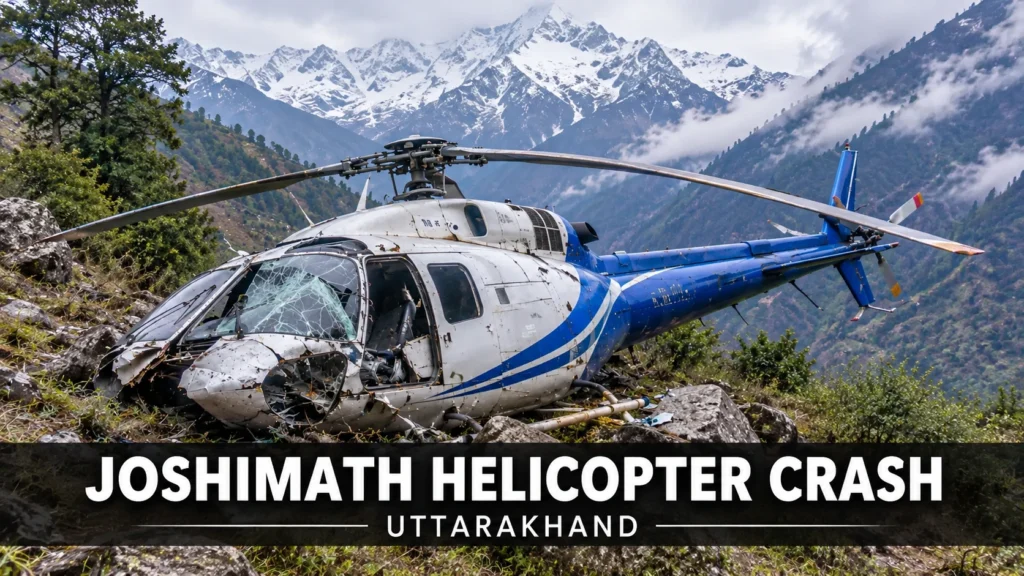
The Joshimath Helicopter Crash has claimed six lives after a helicopter operated by Trans Bharat Aviation crashed in Uttarakhand’s Chamoli district on October 30, 2026. The aircraft was travelling from Badrinath to Dehradun when it crashed in a forested area near Chai village in the Joshimath valley. The victims included the pilot and five passengers who were returning from a pilgrimage to Badrinath.
The accident has raised fresh concerns about aviation safety in the Himalayan region, where helicopter services play an important role in religious tourism. Authorities have confirmed the deaths and initiated an investigation to determine what happened. Although weather conditions have drawn attention, the precise cause of the accident has not yet been officially established.
Joshimath Helicopter Crash: What Happened on October 30?
According to the Ministry of Civil Aviation, the helicopter belonged to Trans Bharat Aviation Private Limited. It was an AS350B3 aircraft registered as VT-HCX and was operating a flight from Badrinath’s helipad to the Sahastradhara helipad in Dehradun.
The helicopter took off from Badrinath at approximately 1:14 p.m. on Friday, October 30, with six people aboard. During the flight, communication was lost while the aircraft was travelling over the Joshimath valley. Its location-tracking signal also stopped being received, prompting authorities to initiate a search operation.
The wreckage was subsequently located near Chai village in the Hathi Parvat area of Chamoli district. Reports placed the crash near the Marwari Bridge and JP Power House area.
The Joshimath Helicopter Crash quickly became a major concern for local authorities because the aircraft had disappeared while carrying passengers through a remote mountainous region. Search teams were dispatched to locate the helicopter and determine the condition of everyone aboard.
Officials later confirmed that all six people had died. The Directorate General of Civil Aviation dispatched a team to Dehradun for an initial regulatory assessment of the accident.
Joshimath Helicopter Crash: Who Were the Six Victims?
The accident killed the pilot, Captain Himanshu Sabharwal, aged 48, and five passengers from Karnataka. The passengers were reported to be from Bengaluru and other parts of the state.
News reports identified the passengers as Arun Salunke, a Bengaluru police inspector associated with the Central Crime Branch; Pratap Gowda Bachihalli; Shankar Gowda VB; Sudhir K; and H. S. Nataraja. Reports also described the passengers as friends travelling together on a Char Dham pilgrimage.
Arun Salunke’s death was particularly significant for his colleagues in Bengaluru’s police department. Shankar Gowda was reported to be an advocate, while H. S. Nataraja was associated with educational and business activities in Karnataka.
The group had travelled to Uttarakhand for a religious journey that included Badrinath, one of the most important Hindu pilgrimage destinations in the Himalayas.
The Joshimath Helicopter Crash has therefore affected families and communities across more than one state. The loss of six lives has also brought attention to the risks faced by passengers using helicopter services to reach destinations in mountainous terrain.
Victim identities and personal details in developing news stories should always be checked against official statements and reliable reporting before publication.
Joshimath Helicopter Crash: Rescue Operations in the Mountains
Reaching the crash site proved challenging because of the surrounding forest and difficult Himalayan terrain. Steep slopes, limited access routes and fading daylight complicated the work of emergency personnel.
Teams from the district administration, police, State Disaster Response Force, Army and Indo-Tibetan Border Police participated in the search and recovery efforts. Drone and aerial reconnaissance support was also reported during the operation.
The initial search focused on locating the missing aircraft after communication and tracking signals were lost. Once the wreckage was identified, rescue personnel had to determine the safest way to reach the site and recover the victims.
According to reports published on October 31, recovery efforts had been affected by darkness and hazardous terrain on Friday evening. Teams resumed operations early on Saturday to transport the victims from the remote location.
The incident demonstrated the difficulties faced by emergency responders when an aircraft crashes in a forested Himalayan valley. Unlike accidents near major roads or populated areas, such incidents can require coordinated operations involving several agencies.
The response to the Joshimath Helicopter Crash also highlighted the importance of communication systems, reliable location tracking and effective coordination between aviation authorities and local emergency services.
Joshimath Helicopter Crash: What Caused the Accident?
The precise cause of the accident remains under investigation. Authorities have not established whether weather, a technical problem, operational factors or a combination of circumstances contributed to the crash.
Reports described rain, cloud cover and reduced visibility in the region. These conditions are relevant because mountain flying can become difficult when pilots have limited visibility of surrounding terrain. However, the presence of poor weather does not by itself prove that it caused this accident.
Investigators will need to examine the aircraft wreckage, available flight records, communication information and maintenance documentation. They may also review the pilot’s flight history, the helicopter’s technical condition and whether the flight complied with applicable aviation requirements.
The Aircraft Accident Investigation Bureau is expected to examine the circumstances of the accident. Its work should help establish the sequence of events leading to the crash and identify any safety lessons that may be relevant to future operations.
The Joshimath Helicopter Crash should not be attributed to pilot error, mechanical failure or weather alone until reliable investigative findings support such a conclusion.
An evidence-based investigation is essential not only to explain the tragedy but also to identify practical measures that could reduce the risk of similar accidents.
Joshimath Helicopter Crash Raises Concerns About Char Dham Safety
Uttarakhand attracts large numbers of pilgrims who travel to religious destinations in the Himalayan region. Badrinath is one of the four major shrines associated with the Char Dham pilgrimage, alongside Kedarnath, Gangotri and Yamunotri.
Helicopter services can reduce travel time and help pilgrims reach destinations where roads are long, difficult or physically demanding. For some travellers, these flights provide an important alternative to lengthy journeys through mountainous terrain.
However, helicopter operations in the Himalayas involve particular challenges. Weather can change rapidly, visibility can deteriorate, and narrow valleys leave less room for pilots to respond to unexpected situations. Safe operations therefore depend on careful planning, appropriate aircraft maintenance, pilot training and conservative decisions when conditions are unsuitable.
The Joshimath Helicopter Crash has renewed attention on these risks. A report discussed by Indian news organisations recorded eight helicopter accidents and one serious incident in Uttarakhand’s Char Dham sector between 2015 and 2025.
That history makes continued safety reviews important. Aviation authorities and operators must assess whether flight schedules, weather assessments, maintenance practices and operational procedures adequately address the challenges of mountain flying.
The objective should be to ensure that the demand for faster pilgrimage travel never takes priority over passenger and crew safety.
Joshimath Helicopter Crash: Trans Bharat Aviation Fleet Grounded
Following the accident, reports stated that the entire fleet operated by Trans Bharat Aviation had been grounded as a precautionary measure.
Grounding an operator’s aircraft can allow authorities to assess safety and compliance concerns before services resume. It does not, by itself, establish that a technical defect or regulatory violation caused the crash.
The next steps will depend on the findings of aviation officials and the outcome of the investigation. Relevant checks may include aircraft maintenance records, operational procedures, pilot qualifications and compliance with applicable Directorate General of Civil Aviation requirements.
Authorities will also need to determine whether any broader safety changes are necessary for helicopter operations in Uttarakhand.
For passengers, the most important consideration is that services resume only when the relevant safety requirements have been met. Clear communication from aviation authorities can help travellers understand operational changes without relying on speculation.
The Joshimath Helicopter Crash has made these checks especially important because the flight was carrying pilgrims returning from Badrinath.
Joshimath Helicopter Crash: What Happens Next?
The investigation will be central to understanding why the helicopter crashed and whether the accident reveals wider safety concerns.
Investigators may review the aircraft’s condition, available flight information, communication records and weather data from the route. They may also examine the operator’s procedures and the decisions made before and during the flight.
If investigators identify safety deficiencies, their findings may lead to recommendations for operators or aviation regulators. Such recommendations can help improve operating procedures, strengthen oversight and reduce risks on similar routes.
Families of the victims will also be waiting for reliable answers about the circumstances surrounding the deaths. Authorities must communicate confirmed findings carefully and avoid presenting preliminary assumptions as established facts.
For travellers planning helicopter journeys in Uttarakhand, official weather advisories and operator announcements remain important sources of information. Passengers should follow instructions issued by authorised personnel and understand that flights may be delayed or cancelled when safety conditions require it.
The Joshimath Helicopter Crash is a reminder that aviation safety requires constant attention, particularly in challenging geographical environments.
Conclusion
The Joshimath Helicopter Crash on October 30, 2026, killed six people after a Trans Bharat Aviation helicopter travelling from Badrinath to Dehradun crashed near Chai village in Chamoli district. The victims included the pilot and five passengers returning from a pilgrimage.
Authorities located the wreckage, confirmed the deaths and began examining the circumstances of the accident. Although poor weather and limited visibility have been discussed in news reports, the official cause has not yet been established.
The investigation will be important in determining what happened and whether further precautions are needed for helicopter operations in Uttarakhand. The tragedy also reinforces the importance of reliable aviation oversight, careful weather assessments and safety-first decisions on routes through the Himalayas.
Khabar Khojo will continue to follow verified updates from the authorities and report any confirmed developments in the investigation.
Frequently Asked Questions
1. When did the Joshimath Helicopter Crash happen?
The accident occurred on October 30, 2026, near Chai village in the Joshimath area of Chamoli district, Uttarakhand.
2. How many people died in the Joshimath Helicopter Crash?
Six people died: the pilot and five passengers who were travelling from Badrinath to Dehradun.
3. What caused the Joshimath Helicopter Crash?
The official cause remains under investigation. Weather conditions, aircraft records and other operational factors may be examined by aviation investigators.
4. Which company operated the helicopter?
The helicopter was operated by Trans Bharat Aviation Private Limited. The aircraft was an AS350B3 registered as VT-HCX.
5. Is the Joshimath Helicopter Crash investigation complete?
The investigation was initiated after the accident, but a final determination of the cause had not been established in the reports available on October 31, 2026.
Follow Khabar Khojo
Follow @officialkhabarkhojo on Instagram for breaking news, India and world updates, business, markets, technology, sports, entertainment and other important stories.
Also read more of such a news on our India News.



More Stories
Mumbai Local Train Services Resume After 10-Hour Halt
Jio Platforms IPO 2026 Details: Why Is It Making Headlines?
SBI Customer Data Leak and Safety Measures: 5 Smart Tips