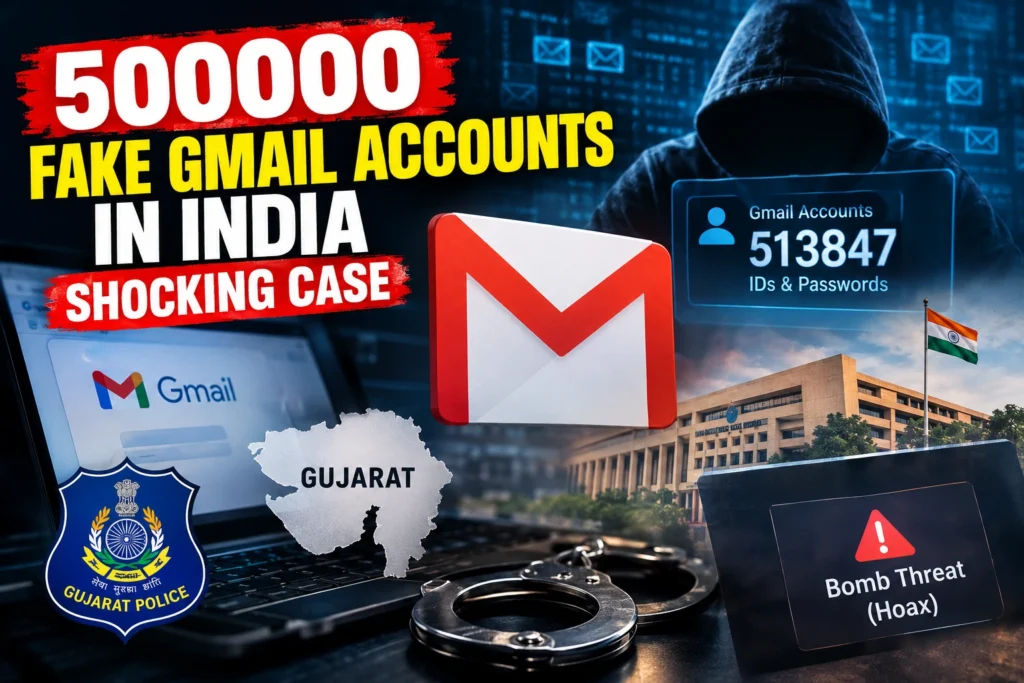
The discovery of 500000 fake Gmail accounts in India has opened a major cybercrime investigation in Gujarat after police uncovered a network allegedly connected to hoax bomb threats sent to government offices.
However, there is an important distinction in the numbers. Gujarat Police uncovered 513847 Gmail IDs and passwords during the investigation. The phrase 500000 fake Gmail accounts in India is therefore a rounded description of the scale of the network, while 513847 is the specific figure reported by investigators.
The network had reportedly been operating since 2022. The investigation began after a bomb threat email reached the Gujarat government on September 10, 2026, shortly before the BRICS summit in New Delhi. Police later traced the digital activity and uncovered the much larger collection of Gmail credentials.
Two people have been arrested so far. Police are now investigating who created the accounts, how they were maintained, how many were actually used and whether other people were involved in the wider network.
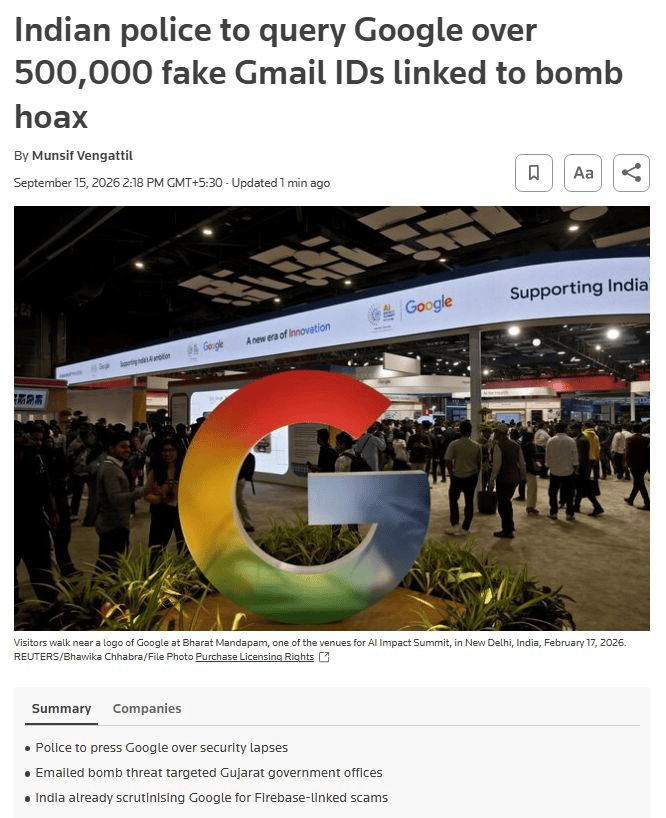
The case has also brought Google into the investigation, with Gujarat Police planning to question the company about safeguards surrounding the creation and use of such a large number of accounts.
500000 fake Gmail accounts in India: What police actually uncovered
The investigation involving 500000 fake Gmail accounts in India began with a bomb threat but eventually revealed a much larger digital network.
According to the latest reporting, Gujarat Police found 513847 Gmail IDs and passwords that investigators said had been used in the network since 2022.
That number is significant, but it needs to be understood correctly.
Police have not said that all 513847 accounts were definitely used to send bomb threats. Instead, investigators discovered the Gmail IDs and passwords while tracing the network behind the hoax threats.
This means the exact role of every account is still being investigated.
Police are trying to establish which accounts were active, who controlled them, who may have purchased them and whether they were used for purposes beyond the bomb-hoax emails.
The distinction matters because describing every account as a confirmed bomb-threat account would go beyond what investigators have established so far.
500000 fake Gmail accounts in India: How the investigation started
The case involving 500000 fake Gmail accounts in India began after a threatening email was received by the Gujarat government on September 10, 2026.
The email contained a bomb threat and also referred to countries cooperating with India around the BRICS summit in New Delhi.
Because the message involved government institutions and came shortly before a major international summit, authorities treated the threat seriously.
Investigators began tracing the email and examining the digital trail behind it.
The threat was eventually found to be false. However, the investigation did not end there.
Instead, police discovered information pointing toward a much larger email network.
That investigation eventually led authorities to the discovery of 513847 Gmail IDs and passwords and the arrest of two people.
500000 fake Gmail accounts in India: Network reportedly active since 2022
One of the most important details in the 500000 fake Gmail accounts in India case is the reported timeline.
According to investigators, the network had been operating since 2022.
This suggests that the operation was not created specifically for the September 2026 bomb threat.
Instead, investigators believe the network had been active for several years, making it important to determine what happened to the accounts during that period.
Police are now examining the history of the accounts, their login credentials and possible links between different users.
The investigation could reveal whether the accounts were created for one specific purpose or whether they were part of a broader system in which accounts were created, stored and later transferred to other users.
The longer timeline could also help investigators identify additional people involved in the operation.
500000 fake Gmail accounts in India and the September 10 bomb threat
The September 10 email is at the centre of the 500000 fake Gmail accounts in India investigation.
According to police, the email was sent to the Gujarat government and contained a false bomb threat.
The message also referred to countries cooperating with India during the BRICS summit in New Delhi.
The timing made the threat particularly sensitive because the summit involved several major international leaders and heightened security arrangements.
Investigators traced the email and eventually identified connections leading to the wider network.
The Indian Express reported that Gujarat Police traced the threat to Bhagalpur in Bihar while continuing their investigation into the message and the people behind it.
The threat ultimately proved to be false, but it exposed a much larger cybercrime operation.
500000 fake Gmail accounts in India: Two people arrested
The investigation into 500000 fake Gmail accounts in India has so far resulted in the arrest of two people.
Police are examining their alleged roles in creating, managing or distributing the Gmail accounts.
The arrests are only one part of the wider investigation.
Authorities are also examining digital evidence, account credentials, communication records and possible financial transactions to understand how the network operated.
Investigators want to determine whether the two arrested individuals were directly responsible for the bomb-threat emails or whether they were part of a larger network supplying accounts to other people.
That distinction could become important as the investigation progresses.
500000 fake Gmail accounts in India: The Bangladesh connection
The 500000 fake Gmail accounts in India investigation has also revealed an alleged international connection.
According to Reuters, one of the arrested individuals was in contact with a buyer in Bangladesh who allegedly purchased batches of the accounts.
Police said some payments were made using cryptocurrency.
This has added another layer to the investigation because authorities now need to determine who purchased the accounts, how they were used and whether the buyers were connected to the bomb threats.
However, the alleged Bangladesh connection should not be interpreted as evidence that the entire operation was controlled from Bangladesh.
Investigators are still working to establish the exact relationships between the people involved.
The use of cryptocurrency could also make the financial investigation more complicated, as authorities attempt to trace payments and identify the people behind the transactions.
500000 fake Gmail accounts in India raise questions about security
The discovery of 500000 fake Gmail accounts in India has raised important questions about online account security.
Police were reportedly concerned that the fraudulent accounts used two-factor authentication, an additional security measure designed to make unauthorised access more difficult.
This has become one of the technical aspects of the investigation.
Authorities want to understand how such a large number of accounts could be created and maintained while using an additional security feature.
The question is not simply how the accounts were created.
Investigators also want to know how they were verified, how access was maintained and whether automated or other methods were used to manage them.
The answers could help authorities understand how similar networks might be detected in the future.
500000 fake Gmail accounts in India: Why Google is being questioned
The 500000 fake Gmail accounts in India case has now brought Google directly into the investigation.
Gujarat Police have said they plan to question the company about the safeguards surrounding account creation.
Reuters reported that police intend to ask Google about possible policy changes so that safeguards cannot be bypassed on such a large scale. Google had not immediately responded to Reuters’ request for comment.
This does not mean that Google has been accused of intentionally enabling the network.
Instead, investigators are examining whether weaknesses in the account-creation process were exploited by the people behind the operation.
The case could therefore lead to a broader discussion about how technology platforms identify unusual patterns involving large numbers of accounts.
500000 fake Gmail accounts in India and the role of two-factor authentication
Another unusual detail in the 500000 fake Gmail accounts in India investigation is the reported use of two-factor authentication.
Two-factor authentication normally provides an additional layer of protection by requiring another form of verification beyond a password.
Police are now trying to understand how the network managed this security requirement across such a large number of accounts.
If investigators determine how the accounts were created and maintained, the findings could help technology companies strengthen systems designed to detect large-scale account abuse.
It could also help law enforcement identify similar networks earlier.
At this stage, however, investigators have not publicly provided every technical detail about how the accounts were created.
500000 fake Gmail accounts in India show the scale of modern cybercrime
The 500000 fake Gmail accounts in India case highlights how cybercrime can operate at a scale far beyond individual online accounts.
A single fake account can be relatively difficult to trace, but a network involving hundreds of thousands of accounts presents a much bigger challenge.
Large account networks can potentially be used to create different digital identities, communicate with different people and make it harder for investigators to connect separate incidents.
In this case, police discovered the network while investigating a bomb threat.
That means the investigation is now focused not only on the original email but also on the infrastructure that may have supported the wider operation.
500000 fake Gmail accounts in India and the impact of hoax threats
The investigation into 500000 fake Gmail accounts in India also shows why online bomb threats are treated seriously even when they eventually prove false.
A bomb threat can force authorities to search buildings, increase security, deploy emergency teams and disrupt normal activities.
Government offices and other public institutions may need to temporarily restrict access while security teams determine whether a threat is genuine.
The September 10 threat came at a particularly sensitive time because of the BRICS summit in New Delhi.
Although the threat proved false, authorities still had to investigate it seriously.
The discovery of the larger Gmail network demonstrates how a single threatening message can sometimes lead investigators toward a much wider cybercrime operation.
500000 fake Gmail accounts in India: What investigators still need to find out
There are several unanswered questions in the 500000 fake Gmail accounts in India case.
Investigators still need to establish:
- Who created the 513847 Gmail IDs?
- How were the accounts created and verified?
- How many of them were actually used?
- Who controlled the accounts?
- Who purchased batches of accounts?
- How were the accounts transferred?
- What role did the arrested individuals play?
- Who was behind the alleged overseas transactions?
- Were the accounts used only for bomb hoaxes or for other forms of cybercrime?
- How did the network maintain access to so many accounts?
The answers could determine the actual size and structure of the suspected network.
It is also possible that investigators will identify additional people as they analyse the digital and financial evidence.
500000 fake Gmail accounts in India: Key facts
| Detail | What investigators have reported |
|---|---|
| Exact number of Gmail IDs and passwords | 513847 |
| Rounded description | 500000+ accounts |
| Network reportedly active since | 2022 |
| Arrests so far | 2 |
| State leading the investigation | Gujarat |
| Initial incident | Bomb-hoax email |
| Threat received | September 10, 2026 |
| Alleged overseas connection | Bangladesh |
| Reported payment method | Cryptocurrency |
| Security feature reported on accounts | Two-factor authentication |
| Technology company being questioned |
The exact figure of 513847 comes from the latest reporting on the Gujarat Police investigation. The larger investigation is still ongoing, and authorities have not established that every account was used for bomb threats.
500000 fake Gmail accounts in India: What happens next
The investigation into 500000 fake Gmail accounts in India is expected to continue as police examine the seized account information and digital evidence.
Authorities will likely focus on identifying which accounts were actually used and who controlled them.
The alleged Bangladesh connection will also require further investigation, particularly regarding the buyers who reportedly purchased batches of accounts.
The financial trail could provide additional information if investigators are able to connect cryptocurrency transactions with specific individuals.
Another major step will be communication with Google.
Police have already indicated that they want to discuss the account-creation process and possible changes to security safeguards.
The findings could eventually influence how large-scale account creation is monitored and how suspicious activity is identified.
500000 fake Gmail accounts in India: What users should know
The 500000 fake Gmail accounts in India investigation does not mean that ordinary Gmail users are automatically at risk.
However, the case is a reminder that people should take basic account-security measures seriously.
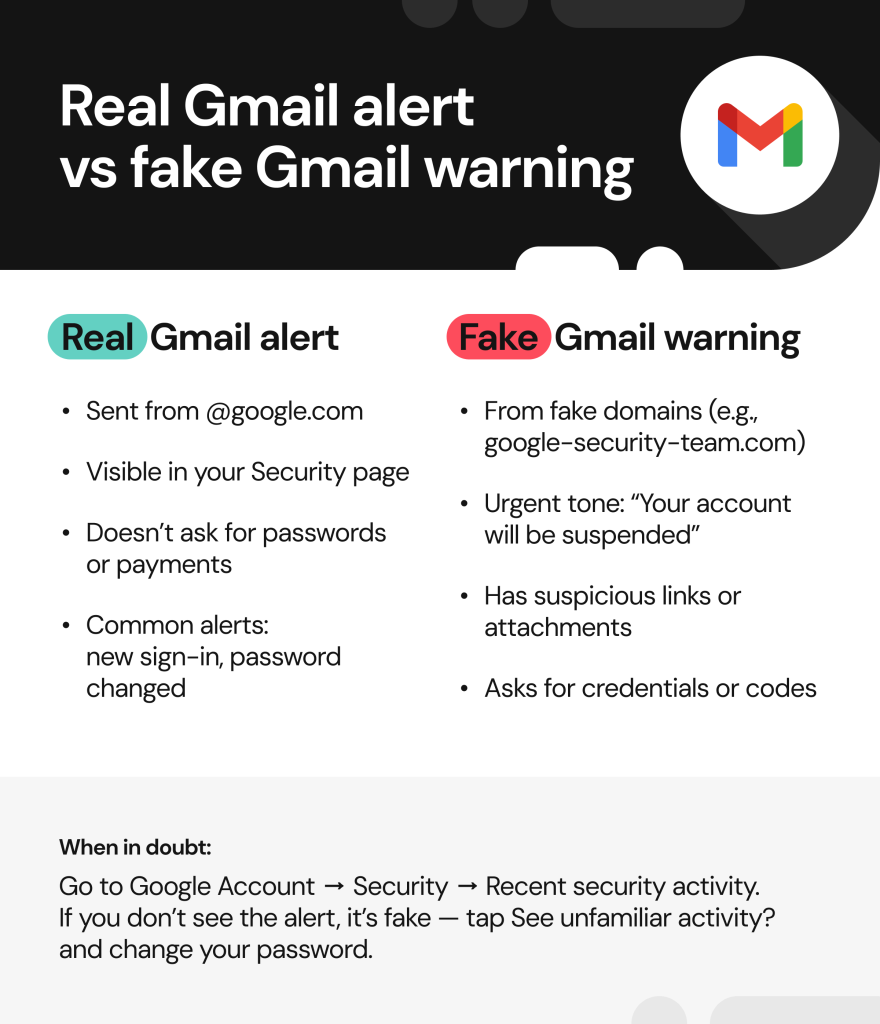
Users should create strong and unique passwords and enable two-factor authentication on their personal accounts.
They should also avoid sharing passwords, verification codes or recovery information with unknown people.
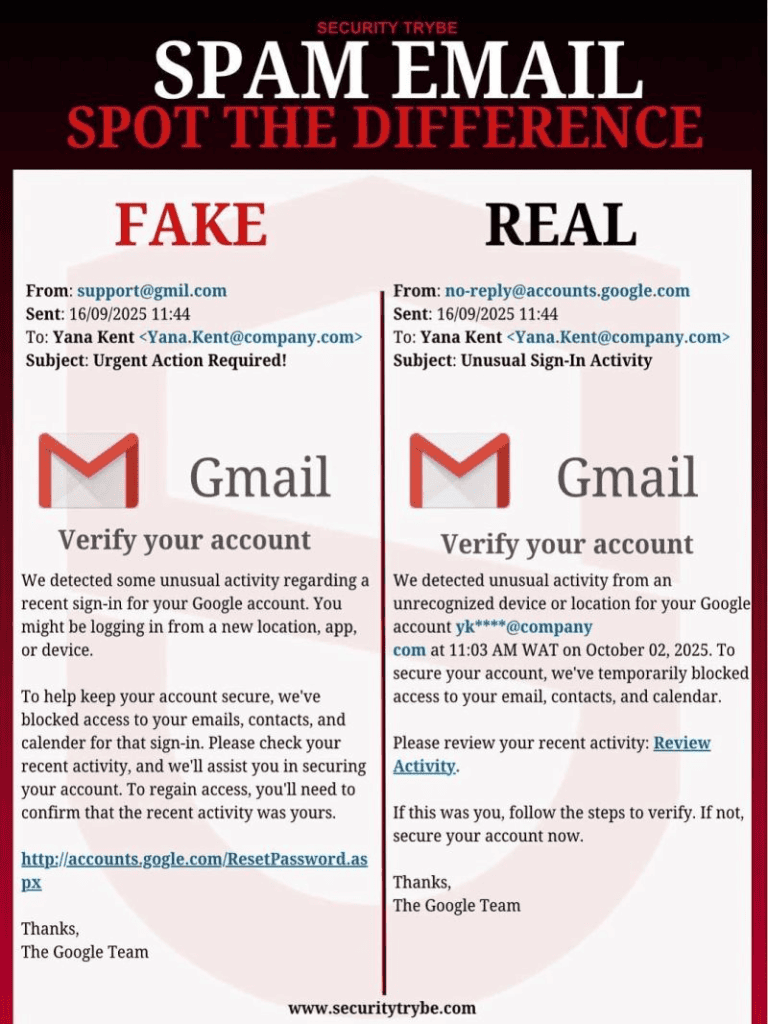
Suspicious emails should be checked carefully before clicking links or opening attachments.
At the same time, users should not assume that their accounts have been compromised simply because a large number of fraudulent accounts were uncovered.
The Gujarat investigation concerns a specific network, and authorities are still determining its full scope.
500000 fake Gmail accounts in India: The bigger cybersecurity lesson
The 500000 fake Gmail accounts in India case is bigger than the original bomb threat.
It raises a broader question about how legitimate digital services can be misused on a massive scale.
Email services are essential tools for communication, but they can also be abused for spam, fraud, impersonation, harassment and false threats.
The challenge for technology companies is to identify coordinated abuse without creating unnecessary barriers for genuine users.
For law enforcement, the challenge is to move beyond individual accounts and identify the people and organisations operating the network.
The Gujarat case demonstrates why digital investigations increasingly require cooperation between police, technology companies and financial investigators.
500000 fake Gmail accounts in India: Conclusion
The discovery of 500000 fake Gmail accounts in India has turned a Gujarat bomb-hoax investigation into a much wider cybercrime case.
The exact figure reported by police is 513847 Gmail IDs and passwords, with the network reportedly operating since 2022. The investigation began after a false bomb threat reached the Gujarat government on September 10, 2026.
Two people have been arrested, while investigators continue examining the wider network, its alleged Bangladesh connection and the reported use of cryptocurrency.
The case has also raised questions about how such a large number of accounts could be created and maintained, particularly because investigators said the fraudulent accounts used two-factor authentication.
Police now plan to question Google about its safeguards and possible policy changes.
One point remains especially important: 513847 Gmail IDs and passwords were uncovered, but investigators have not established that all of those accounts were used for bomb threats.
As the investigation continues, authorities will be looking at the people behind the accounts, the buyers who may have obtained them, the financial trail and the technology used to maintain the network.
The 500000 fake Gmail accounts in India case could ultimately become an important example of how large-scale digital networks are being used in modern cybercrime—and how law enforcement and technology companies respond when online abuse reaches an unprecedented scale.
FAQs on 500000 fake Gmail accounts in India
1. How many Gmail IDs did Gujarat Police uncover?
Gujarat Police uncovered 513847 Gmail IDs and passwords during the investigation.
2. Were all 513847 Gmail accounts used for bomb threats?
No. Investigators have not established that every account was used for bomb threats. They are still determining how many accounts were actually used and what role they played in the wider network.
3. When did the network reportedly begin operating?
According to the latest reporting, the network had reportedly been operating since 2022.
4. What started the investigation?
The investigation began after a bomb threat email was received by the Gujarat government on September 10, 2026.
5. Why is Google being questioned?
Gujarat Police want to understand how such a large number of accounts could be created and maintained and whether safeguards surrounding account creation were bypassed. Police have indicated that they plan to ask Google about possible policy changes.
Follow Khabar Khojo
Follow @officialkhabarkhojo for breaking news, India and world updates, business, markets, technology, sports, entertainment, lifestyle and exclusive stories.
Also read more of such a news on our India News




More Stories
Asarva Water Tank Incident: Remains Found, AMC Orders Probe
Silver Oak Student Death Ahmedabad: Shocking Crane Accident Tragedy
SMA Type 1 Treatment Cost: ₹6.33 Crore Help Brings Hope