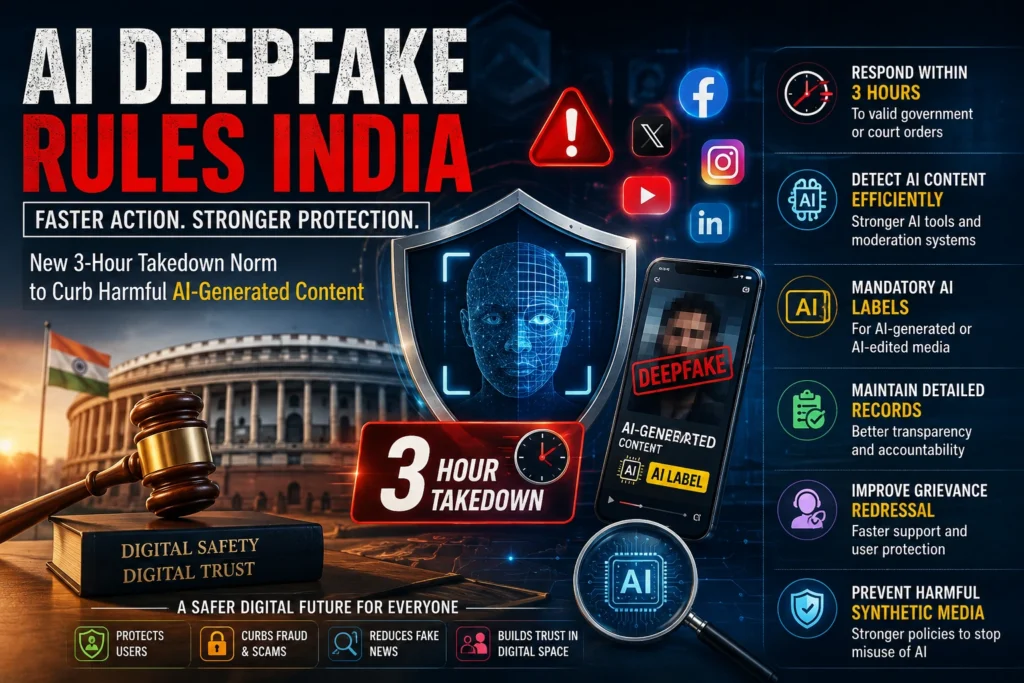
Artificial Intelligence is changing the way people create and consume digital content. From realistic AI-generated videos to cloned voices and manipulated images, technology has reached a point where it is becoming increasingly difficult to tell what is real and what is fake. While AI has unlocked new opportunities for creators and businesses, it has also opened the door to misinformation, online scams, identity theft, and digital fraud.
To tackle these growing concerns, the Government of India has proposed significant changes under the AI Deepfake Rules India. The draft amendments seek to reduce the deadline for removing unlawful AI-generated content from 36 hours to just 3 hours after a valid government or court order. In addition, AI-generated videos, images, audio, and text may soon be required to carry clear labels so users can easily identify synthetic content.
If implemented, the AI Deepfake Rules India could become one of the country’s biggest digital policy updates in recent years. The proposal is expected to affect social media platforms, AI companies, content creators, businesses, and millions of internet users who consume digital content every day.
The government’s move comes at a time when deepfake technology has become more accessible than ever. Free AI tools can now generate convincing videos, voice recordings, and images within minutes. While many people use these tools for creativity and entertainment, cybercriminals have increasingly exploited them for financial fraud, fake news, political misinformation, and impersonation scams. The proposed AI Deepfake Rules India aim to strike a balance between encouraging AI innovation and protecting citizens from the harmful misuse of artificial intelligence.
What Are the AI Deepfake Rules India?
The proposed AI Deepfake Rules India are part of the government’s efforts to strengthen India’s digital safety framework under the Information Technology (IT) Rules. The new proposals focus on increasing transparency around AI-generated content while ensuring that harmful or unlawful synthetic media can be removed much faster than before.
Under the proposed framework, online intermediaries—including social media platforms, video-sharing websites, search engines, and AI service providers—could be required to comply with two major obligations:
- Remove unlawful AI-generated content within 3 hours of receiving a valid government or court direction, replacing the earlier 36-hour deadline.
- Clearly label AI-generated or AI-edited content so users know when they are viewing synthetic media.
The AI Deepfake Rules India are designed to make digital platforms more accountable while giving users better protection against manipulated content.
Why Is the Government Tightening AI Deepfake Rules India?
The government believes that existing timelines are no longer sufficient in an era where a fake video can reach millions of people within a few hours. Earlier, platforms generally had up to 36 hours to act on valid takedown directions. However, today’s social media environment moves much faster.
A manipulated video uploaded in the morning can trend nationwide before the end of the day. Even if it is removed later, the damage may already be irreversible. This challenge is one of the main reasons behind the proposed AI Deepfake Rules India.
Authorities are particularly concerned about the growing misuse of AI in areas such as:
- Fake political speeches during elections.
- Celebrity deepfake videos.
- Voice cloning used for financial scams.
- AI-generated explicit content.
- Identity theft and impersonation.
- Fake news designed to influence public opinion.
By shortening the response window to three hours, the government hopes to reduce the spread of harmful content before it gains widespread visibility.
36 Hours to 3 Hours: What Exactly Has Changed?
The most talked-about feature of the AI Deepfake Rules India is the dramatic reduction in the content removal timeline.
Earlier Rule
Under the previous framework, intermediaries generally had 36 hours to remove unlawful content after receiving a valid government or court order.
Proposed Rule
The revised AI Deepfake Rules India reduce this timeline to 3 hours for unlawful AI-generated content covered by the new proposal.
Although this may appear to be a simple procedural change, it represents a significant shift in how online platforms will be expected to respond to harmful synthetic media.
The shorter timeline is intended to:
- Reduce the viral spread of deepfake videos.
- Minimise public misinformation.
- Protect victims more quickly.
- Improve accountability among digital platforms.
- Strengthen trust in India’s online ecosystem.
For large technology companies, this proposal could require faster moderation systems, improved AI detection tools, and stronger compliance teams.
Mandatory AI Labels: A Major Shift Towards Transparency
Another important proposal under the AI Deepfake Rules India is the introduction of mandatory labels for AI-generated content.
If these rules are implemented, AI-created or AI-edited material may need to include a visible disclosure indicating that the content has been generated or significantly modified using artificial intelligence.
Possible labels may include:
- AI Generated
- AI Assisted
- AI Edited
- Synthetic Media
- Digitally Altered Content
The primary objective is to help users make informed decisions before believing or sharing online content.
This measure is also expected to support journalists, researchers, educators, and fact-checkers who increasingly deal with manipulated digital media.
Why AI Deepfakes Have Become a Serious Concern
The rapid growth of generative AI has made deepfake creation easier than ever before. Earlier, producing realistic fake videos required advanced technical skills. Today, several AI tools can generate convincing content within minutes.
This has led to a sharp rise in incidents involving:
- Fake investment promotions.
- Voice-cloning scams.
- Fraud involving government officials.
- Deepfake celebrity advertisements.
- Manipulated news clips.
- AI-generated misinformation during major public events.
The proposed AI Deepfake Rules India aim to reduce these risks without slowing down innovation in artificial intelligence. Instead of restricting AI development, the government is focusing on transparency, accountability, and quicker enforcement against unlawful content.
How Will AI Deepfake Rules India Affect Social Media Platforms?
The proposed AI Deepfake Rules India are expected to bring one of the biggest compliance changes for social media companies operating in India. Platforms such as Facebook, Instagram, X (formerly Twitter), YouTube, LinkedIn, and other intermediaries may have to redesign parts of their moderation systems to meet the proposed three-hour takedown timeline.
Unlike the previous framework, where moderation teams had more time to review reported content, the new proposal leaves very little room for delay. This means companies may increasingly rely on AI-powered detection systems, dedicated compliance teams, and faster coordination with legal authorities.
Under the proposed AI Deepfake Rules India, platforms may need to:
- Respond to valid government or court orders within three hours.
- Detect AI-generated content more efficiently.
- Display labels on AI-generated or AI-edited media where applicable.
- Maintain detailed compliance records.
- Improve grievance redressal mechanisms for users.
- Strengthen internal policies to prevent the spread of harmful synthetic media.
For global technology companies, India could become one of the first major markets requiring such rapid action against unlawful AI-generated content.
How Will AI Deepfake Rules India Impact Content Creators?
The proposed AI Deepfake Rules India are not intended to stop people from using artificial intelligence. Instead, they aim to ensure that AI is used responsibly and transparently.
For YouTubers, filmmakers, advertisers, marketers, influencers, and designers, AI has become a powerful creative tool. Many creators already use AI for voice enhancement, image generation, subtitles, video editing, and content production.
However, creators may soon need to be more transparent about how AI is being used in their content.
For example, creators could be expected to:
- Clearly disclose AI-generated visuals.
- Mention when AI voices are used.
- Avoid publishing misleading AI-generated news.
- Refrain from impersonating real individuals without consent.
- Follow platform-specific AI disclosure policies.
The AI Deepfake Rules India are likely to encourage ethical AI adoption rather than discourage innovation.
What Do the AI Deepfake Rules India Mean for Ordinary Users?
For millions of internet users, the biggest advantage of the proposed AI Deepfake Rules India is stronger digital protection.
Today, almost anyone can become the target of a deepfake. A single photograph and a short audio clip are often enough for AI tools to create convincing fake videos or cloned voices.
The proposed rules are expected to provide several benefits:
Faster Removal of Harmful Content
If a deepfake video is found to violate the law and a valid direction is issued, platforms could be required to remove it within three hours instead of waiting much longer.
Better Transparency
Mandatory AI labels can help users distinguish authentic media from AI-generated content before they share or react to it.
Stronger Protection Against Online Fraud
Many cybercriminals now use AI-generated voices to impersonate relatives, company executives, or government officials. Faster action could reduce the spread of such scams.
Improved Privacy
Victims of AI-generated explicit images or impersonation may receive quicker protection if unlawful content is taken down sooner.
The proposed AI Deepfake Rules India therefore focus not only on technology companies but also on protecting everyday internet users.
Challenges in Implementing AI Deepfake Rules India
Although the proposal has been widely discussed, implementing the AI Deepfake Rules India will not be easy.
Detecting High-Quality Deepfakes
Modern AI models generate extremely realistic videos and voices. Detecting manipulated content accurately remains one of the biggest technical challenges.
Balancing Speed and Accuracy
A three-hour deadline leaves limited time for reviewing reports. Platforms will need to ensure that genuine content is not mistakenly removed while still acting quickly against unlawful material.
Increasing Compliance Costs
Large technology companies may need to invest in:
- AI detection systems.
- Additional moderation teams.
- Legal compliance departments.
- Better reporting infrastructure.
- Advanced content verification technologies.
These investments could significantly increase operational costs.
Cross-Border Enforcement
Many platforms operate globally. Aligning international moderation systems with India’s proposed requirements could require major operational changes.
Experts React to AI Deepfake Rules India
Cybersecurity experts, AI researchers, and digital policy analysts have generally welcomed the government’s efforts to address the rapid growth of deepfake technology.
Many experts believe the proposed AI Deepfake Rules India could:
- Reduce AI-enabled fraud.
- Slow the spread of fake news.
- Improve accountability among technology companies.
- Build public trust in artificial intelligence.
- Encourage responsible AI innovation.
However, experts also stress that implementation should remain balanced. Clear definitions, transparent enforcement, and proper appeal mechanisms will be important to ensure that legitimate content is not unfairly removed.
Some digital rights advocates have also called for safeguards that protect freedom of expression while tackling harmful AI-generated content.
How Does India Compare With Other Countries?
Governments around the world are working on laws to regulate AI-generated content, but their approaches differ.
- European Union: Focuses on transparency requirements under the AI Act, including disclosure obligations for certain AI-generated content.
- United States: Several states have introduced laws targeting election-related deepfakes and non-consensual AI-generated explicit content.
- China: Requires providers of synthetic media to label AI-generated content and follow strict identity verification measures.
The proposed AI Deepfake Rules India would place India among the countries taking a more proactive approach to regulating deepfake technology, particularly if the three-hour compliance timeline is implemented.
What Should You Do If You Become a Deepfake Victim?
Even with the proposed AI Deepfake Rules India, users should act quickly if they discover fake AI-generated content featuring their image, voice, or identity. While the new rules aim to speed up platform responses, timely reporting by users will remain equally important.
If you believe you have become a victim of a deepfake, follow these steps:
1. Save Evidence Immediately
Take screenshots, copy the URL, note the account name, and record the date and time. This information can help during reporting or legal proceedings.
2. Report the Content on the Platform
Most social media platforms allow users to report manipulated, misleading, or impersonation content. Use the reporting option as soon as possible.
3. File a Cyber Crime Complaint
If the content involves fraud, blackmail, identity theft, or harassment, report it through the National Cyber Crime Reporting Portal or contact your local cyber police.
4. Inform Friends and Family
If someone has cloned your voice or created a fake video using your identity, inform people close to you so they do not fall victim to scams.
The proposed AI Deepfake Rules India may improve response times, but public awareness remains one of the strongest defenses against AI-powered misinformation.
Challenges That Still Need Answers
While the proposal has received significant attention, several important questions remain.
Can Platforms Really Remove Content Within Three Hours?
Large social media companies process millions of posts every day. Building systems that can quickly verify complaints and remove unlawful AI-generated content within three hours will require major technological and operational upgrades.
Who Decides Whether Content Is Illegal?
One of the biggest concerns is ensuring that only genuinely unlawful content is removed. Experts say there must be a transparent process so that satire, parody, journalism, and legitimate creative work are not mistakenly taken down.
How Will AI Labels Be Displayed?
The government has proposed labeling AI-generated content, but the exact format may differ across platforms. Some may use visible badges, while others could rely on metadata or disclosure notices.
These implementation details will determine how effective the AI Deepfake Rules India become in practice.
Why the 3-Hour Rule Could Be a Turning Point
The internet moves faster than ever before. A misleading AI-generated video can reach millions of users in a matter of hours, making delayed action far less effective.
By proposing a three-hour compliance window, the AI Deepfake Rules India acknowledge this new digital reality. Faster takedowns could help:
- Reduce the spread of fake news.
- Limit financial scams using cloned voices.
- Protect victims of AI impersonation.
- Improve trust in online platforms.
- Encourage responsible use of artificial intelligence.
If implemented effectively, the proposal could influence future AI regulations not only in India but also in other countries facing similar challenges.
Frequently Asked Questions (FAQs)
What are the AI Deepfake Rules India?
The AI Deepfake Rules India are proposed amendments to India’s IT framework that would require unlawful AI-generated content to be removed within three hours of a valid government or court direction and introduce labeling requirements for AI-generated media.
Why has the government reduced the deadline from 36 hours to 3 hours?
The proposed change aims to prevent fake AI-generated videos, images, and audio from spreading rapidly across social media before action can be taken.
Will AI-generated content be banned?
No. The proposal does not ban artificial intelligence or AI-generated content. Instead, it focuses on transparency through labels and quicker removal of unlawful material.
Which platforms will be affected?
The proposed AI Deepfake Rules India are expected to apply to social media platforms, online intermediaries, AI service providers, and digital platforms operating in India.
How can users identify AI-generated content?
If the proposal is implemented, platforms may display labels such as “AI Generated,” “AI Edited,” or similar disclosures to help users recognize synthetic media.
Conclusion
The proposed AI Deepfake Rules India represent a major shift in India’s approach to regulating artificial intelligence and synthetic media. By reducing the takedown timeline from 36 hours to just 3 hours and introducing mandatory labeling for AI-generated content, the government is attempting to address one of the fastest-growing digital threats.
While the proposal will increase compliance responsibilities for technology companies, it could also provide stronger protection for internet users against misinformation, impersonation, online fraud, and privacy violations.
As artificial intelligence becomes a part of everyday life, responsible regulation will play a crucial role in maintaining trust in the digital ecosystem. If implemented successfully, the AI Deepfake Rules India could set a new benchmark for balancing technological innovation with user safety.
Stay updated with the latest news and trending stories!
Follow @officialkhabarkhojo https://instagr.am/officialkhabarkhojo on Instagram for quick updates, breaking news, and important stories that matter.
Also read more of such a news on our AI page.



More Stories
Asarva Water Tank Incident: Remains Found, AMC Orders Probe
Silver Oak Student Death Ahmedabad: Shocking Crane Accident Tragedy
SMA Type 1 Treatment Cost: ₹6.33 Crore Help Brings Hope