Key Highlights
- PRL Ahmedabad and CHARUSAT have jointly developed India’s first patented PRL Venus Simulation Chamber for studying planetary lightning.
- The technology was developed after nearly four years of research under ISRO’s RESPOND Programme.
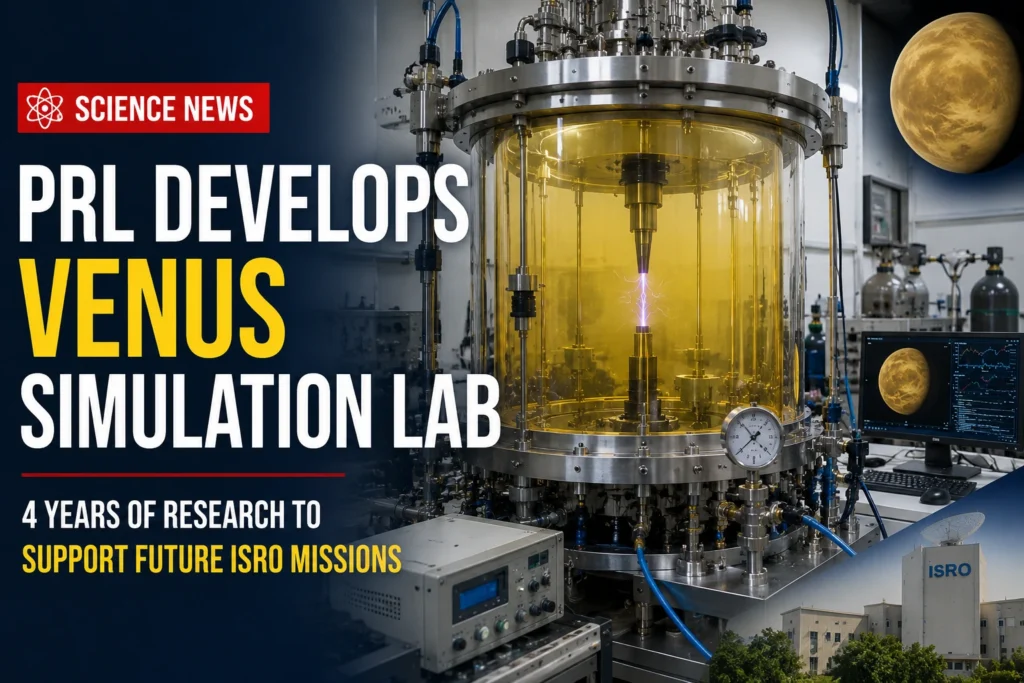
- Scientists can recreate Venus-like atmospheric conditions and generate controlled high-voltage electrical discharges inside a custom-built chamber.
- The research could support ISRO’s proposed Shukrayaan (Venus Orbiter Mission) and future planetary exploration.
- The facility can also contribute to studies related to Jupiter, Saturn, Mars, and other planetary atmospheres.
India Moves Closer to Understanding Venus
India has taken another important step in planetary science with the development of the PRL Venus Simulation Chamber, a specialised research facility designed to recreate the atmospheric conditions of Venus inside a laboratory. The innovative system has been jointly developed by scientists from the Physical Research Laboratory (PRL), Ahmedabad, and Charotar University of Science and Technology (CHARUSAT) after nearly four years of research.
Unlike traditional laboratory equipment, the PRL Venus Simulation Chamber allows researchers to simulate the dense carbon dioxide-rich atmosphere of Venus and generate controlled electrical discharges similar to planetary lightning. The project is expected to strengthen India’s planetary science programme and support future research for ISRO’s proposed Shukrayaan mission, while also helping scientists better understand atmospheric electricity on other planets.
The research represents another milestone for Indian scientists working to expand the country’s capabilities in space science, atmospheric physics, and planetary exploration.
What Is the PRL Venus Simulation Chamber?
The PRL Venus Simulation Chamber is a specially designed laboratory facility built to recreate atmospheric environments found on other planets, particularly Venus. Researchers can carefully control gas composition, pressure, and electrical conditions inside the chamber, allowing them to perform experiments that cannot be conducted directly on the planet.
The chamber is equipped with a customised vacuum system, gas control mechanism, scientific sensors, and high-voltage electrodes. Together, these components enable scientists to study how electrical discharges behave under Venus-like atmospheric conditions.
One of the major objectives of the PRL Venus Simulation Chamber is to investigate planetary lightning—a phenomenon that scientists believe may exist in the thick cloud layers of Venus but remains difficult to observe directly using spacecraft alone.
Because the experiments are performed in a controlled laboratory environment, researchers can repeat them multiple times, compare results, and improve scientific models before future planetary missions are launched.
Why Scientists Are Interested in Venus
Among all the planets in the Solar System, Venus is often considered Earth’s closest planetary twin because of its similar size, mass, and rocky structure. However, the similarities end there.
Venus has one of the most extreme environments known in the Solar System. Its atmosphere is composed primarily of carbon dioxide, while thick clouds containing sulphuric acid surround the planet. Surface temperatures reach around 465°C, making Venus hotter than Mercury despite being farther from the Sun.
Scientists are also interested in understanding whether lightning occurs within Venus’ dense cloud layers. Although several international missions have detected signals that may indicate electrical activity, the existence, frequency, and behaviour of Venusian lightning are still being studied.
The PRL Venus Simulation Chamber provides Indian researchers with an opportunity to investigate these questions under carefully controlled laboratory conditions instead of relying only on spacecraft observations.
How the Four-Year Research Project Began
The development of the PRL Venus Simulation Chamber was not completed overnight. Scientists spent nearly four years designing, testing, and refining the technology to accurately simulate planetary atmospheric conditions.
The research was carried out jointly by PRL Ahmedabad and CHARUSAT under the ISRO RESPOND Programme, which supports academic and scientific research related to India’s space programme.
During the project, researchers developed a specialised experimental setup capable of recreating Venus-like atmospheric conditions while safely producing high-voltage electrical discharges inside a sealed chamber. The technology has also received a patent, highlighting its scientific and technological significance.
According to the researchers, the facility has been designed as a versatile platform that can support future studies involving atmospheric electricity, planetary science, and space instrumentation.
Why the PRL Venus Simulation Chamber Matters
The PRL Venus Simulation Chamber is important because direct experiments on Venus remain extremely difficult. Spacecraft can collect valuable observations, but they operate under severe environmental conditions that limit the duration and scope of experiments.
A laboratory simulation system allows scientists to recreate similar atmospheric conditions on Earth, making it possible to conduct repeated experiments, improve scientific instruments, and validate research findings before future missions are launched.
This capability is particularly valuable for India as it expands its planetary exploration programme. Facilities like the PRL Venus Simulation Chamber reduce dependence on overseas laboratories while strengthening domestic research in atmospheric science, electrical discharge physics, and planetary exploration.
How the PRL Venus Simulation Chamber Recreates Planetary Lightning
One of the most remarkable features of the PRL Venus Simulation Chamber is its ability to recreate lightning-like electrical discharges under controlled laboratory conditions. While lightning is a familiar phenomenon on Earth, scientists are still investigating whether similar electrical activity regularly occurs in the dense atmosphere of Venus. The PRL Venus Simulation Chamber gives researchers a safe environment to reproduce these conditions and analyse how electrical discharges behave in a Venus-like atmosphere.
The experimental setup consists of a specially designed vacuum chamber, a gas handling system, precision sensors, and high-voltage electrodes. Researchers fill the chamber with gases that closely resemble the atmospheric composition of Venus and adjust the pressure to match planetary conditions. Once the desired environment is achieved, controlled high-voltage discharges are generated between the electrodes, allowing scientists to study how lightning forms and propagates under different atmospheric conditions.
Unlike direct observations from spacecraft, laboratory experiments can be repeated several times with different pressure levels, gas mixtures, and electrical parameters. This flexibility enables researchers to collect accurate data and improve scientific models of planetary atmospheres.
Understanding Atmospheric Electricity on Venus
The atmosphere of Venus is one of the most mysterious in the Solar System. It is composed of approximately 96.5% carbon dioxide and 3.5% nitrogen, with thick clouds made primarily of sulphuric acid droplets. These harsh conditions make it extremely difficult for spacecraft to remain operational for extended periods.
Although several international missions have reported evidence that may indicate electrical activity within Venus’ cloud layers, scientists have not yet reached complete agreement on the frequency or characteristics of Venusian lightning. This uncertainty makes laboratory research especially valuable.
Using the PRL Venus Simulation Chamber, scientists can recreate similar atmospheric conditions and investigate questions such as:
- How electrical discharges begin in a dense carbon dioxide atmosphere.
- The voltage required to trigger lightning-like events.
- The electromagnetic signals produced during these discharges.
- The behaviour of charged particles under Venus-like atmospheric pressure.
The data collected from these experiments helps researchers compare laboratory results with observations made by planetary spacecraft, improving scientific understanding of Venus’ atmosphere.
Supporting ISRO’s Future Shukrayaan Mission
The PRL Venus Simulation Chamber has significant importance for India’s future planetary exploration programme. Although ISRO’s proposed Shukrayaan (Venus Orbiter Mission) is still under development, scientists require reliable laboratory facilities to test scientific instruments before they are sent into space.
A simulation chamber allows researchers to expose instruments to Venus-like atmospheric conditions without leaving Earth. Engineers can evaluate sensor performance, verify calibration, and identify possible technical issues before launch. This reduces mission risks and improves the reliability of scientific payloads.
The PRL Venus Simulation Chamber also enables researchers to generate experimental data that can be compared with observations collected during future Venus missions. Such laboratory studies are an important part of preparing scientific instruments for challenging planetary environments.
Why the Research Received a Patent
The research team has also secured a patent for the technology developed during the project. A patent recognises the originality of the system and protects the innovative methods used to simulate planetary atmospheric lightning inside a laboratory environment.
Unlike conventional atmospheric research equipment, the PRL Venus Simulation Chamber combines a customised vacuum chamber, controlled gas delivery system, and high-voltage electrical discharge mechanism into a single experimental platform. This integrated approach enables researchers to perform detailed studies of planetary atmospheric electricity under carefully controlled conditions.
Receiving a patent highlights the technological significance of the project and demonstrates India’s growing capability to design advanced scientific research infrastructure within the country.
Applications Beyond Venus
Although the PRL Venus Simulation Chamber was developed primarily for Venus research, its scientific applications extend far beyond a single planet. By changing the gas composition, atmospheric pressure, and experimental conditions inside the chamber, researchers can investigate electrical processes relevant to other planetary environments.
The technology may support future studies involving:
- Mars, where the thin carbon dioxide atmosphere presents different electrical challenges.
- Jupiter, which experiences some of the most powerful lightning storms in the Solar System.
- Saturn, whose atmosphere also produces large-scale electrical discharges.
- Comparative planetary science, allowing scientists to better understand how atmospheric electricity behaves across different worlds.
This flexibility makes the PRL Venus Simulation Chamber an important research platform not only for Venus but also for broader planetary science and future international space exploration.
Why This Breakthrough Is Important for India
The development of the PRL Venus Simulation Chamber is a significant achievement for India’s scientific community because it strengthens the country’s ability to conduct advanced planetary research within its own laboratories. Until now, many specialised atmospheric simulation experiments required access to international facilities or collaborative research programmes. By developing an indigenous simulation system, Indian scientists now have a dedicated platform to investigate atmospheric electricity, validate scientific theories, and test instruments under controlled planetary conditions.
The PRL Venus Simulation Chamber also reflects India’s growing expertise in space science and atmospheric physics. As planetary exploration becomes a global priority, facilities like this will help Indian researchers contribute original scientific findings rather than relying solely on data collected by foreign missions.
PRL’s Contribution to India’s Space Research
Founded in 1947 by Dr. Vikram Sarabhai, the Physical Research Laboratory (PRL), Ahmedabad, is one of India’s premier research institutions in astronomy, planetary science, atmospheric science, geophysics, and space physics. Operating under the Department of Space, Government of India, PRL has played an important role in supporting several ISRO missions through scientific research and instrument development.
The PRL Venus Simulation Chamber is another example of the institute’s commitment to expanding India’s capabilities in planetary exploration. By creating a laboratory where scientists can recreate Venus-like atmospheric conditions, PRL is providing researchers with valuable opportunities to study electrical phenomena, improve scientific instruments, and support future space missions.
What This Means for Future Planetary Missions
Planetary missions involve years of planning, engineering, and scientific testing before a spacecraft is launched. Every scientific instrument must perform reliably in harsh extraterrestrial environments where repairs are impossible.
The PRL Venus Simulation Chamber allows researchers to expose instruments to simulated planetary conditions before launch. Scientists can evaluate sensor performance, analyse electrical behaviour, and improve the design of future payloads through repeated laboratory experiments.
The knowledge generated from this facility is expected to benefit future research related to Venus, while also supporting comparative studies involving Mars, Jupiter, Saturn, and other planetary bodies. As ISRO continues expanding its planetary exploration programme, facilities like the PRL Venus Simulation Chamber will play an increasingly important role in strengthening India’s scientific preparedness.
Frequently Asked Questions (FAQs)
What is the PRL Venus Simulation Chamber?
The PRL Venus Simulation Chamber is a patented laboratory facility jointly developed by Physical Research Laboratory (PRL), Ahmedabad, and CHARUSAT. It recreates Venus-like atmospheric conditions and generates controlled high-voltage electrical discharges to study planetary lightning and atmospheric electricity.
Why did scientists develop the PRL Venus Simulation Chamber?
Scientists developed the PRL Venus Simulation Chamber to better understand atmospheric electricity on Venus and to provide a controlled laboratory environment for testing scientific instruments that may be used in future planetary missions
How long did the research take?
The development of the PRL Venus Simulation Chamber took nearly four years of research under ISRO’s RESPOND Programme before the technology was successfully demonstrated and patented.
Will the PRL Venus Simulation Chamber support ISRO’s Shukrayaan mission?
While ISRO has not officially confirmed that this exact facility will be used for Shukrayaan, the technology is expected to support planetary research, instrument validation, and atmospheric studies that are relevant to India’s proposed Venus Orbiter Mission (Shukrayaan).
Can the technology be used for planets other than Venus?
Yes. Researchers have stated that the experimental setup can be adapted for studying atmospheric electrical phenomena associated with other planets such as Mars, Jupiter, and Saturn by modifying atmospheric conditions inside the chamber.
Conclusion
The PRL Venus Simulation Chamber represents a major advancement in India’s planetary science research. Developed jointly by PRL Ahmedabad and CHARUSAT after nearly four years of research under ISRO’s RESPOND Programme, the patented facility enables scientists to recreate Venus-like atmospheric conditions and investigate planetary lightning inside a controlled laboratory environment.
Beyond improving scientific understanding of Venus, the PRL Venus Simulation Chamber provides researchers with a powerful platform to test instruments, validate atmospheric models, and prepare for future planetary exploration. As India continues expanding its presence in deep-space research through missions to the Moon, Mars, and the proposed Shukrayaan mission, innovations like this highlight the country’s growing capability to develop world-class scientific infrastructure and contribute meaningful research to the global space science community.
Follow @officialkhabarkhojo https://instagr.am/officialkhabarkhojo for the latest updates and breaking news
Also read more of such a news on our India News .
Official Sources
- Physical Research Laboratory (PRL): https://www.prl.res.in/
- Indian Space Research Organisation (ISRO): https://www.isro.gov.in/
- Department of Space, Government of India: https://www.dos.gov.in/
- Indian Express (Research Coverage): https://indianexpress.com/article/cities/ahmedabad/planetary-lightning-simulation-charusat-prl-patent-india-10759366/




More Stories
Asarva Water Tank Incident: Remains Found, AMC Orders Probe
Silver Oak Student Death Ahmedabad: Shocking Crane Accident Tragedy
SMA Type 1 Treatment Cost: ₹6.33 Crore Help Brings Hope