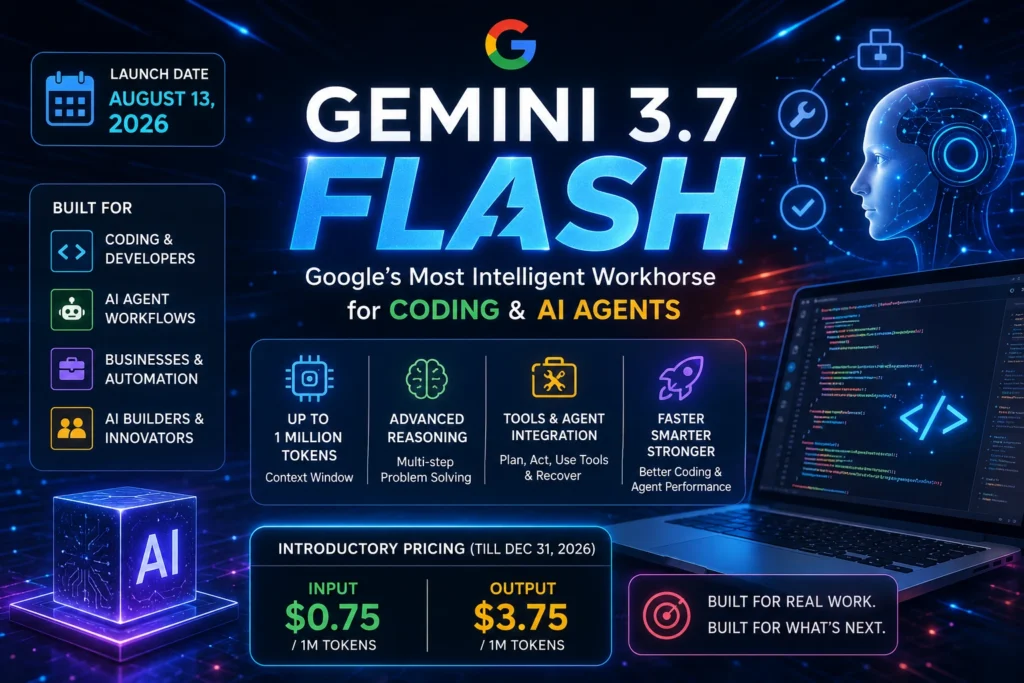
Google has launched Gemini 3.7 Flash, a new AI model built to handle coding, complex workflows and AI-agent tasks with greater speed and efficiency. Introduced on August 13, 2026, the latest addition to the Gemini Flash family is positioned as Google’s most intelligent workhorse model yet for coding and agents.
Unlike a traditional chatbot upgrade, Gemini 3.7 Flash is focused heavily on practical work. Google is targeting developers, businesses and users who want AI systems that can plan tasks, use tools and work through multi-step problems rather than simply generate text.
Gemini 3.7 Flash Launch Date
Google officially introduced Gemini 3.7 Flash on August 13, 2026.
The launch comes during an increasingly competitive AI race involving Google, OpenAI, Anthropic, Meta and other major AI companies. Reuters reported that Google’s new model is specifically aimed at software coding and automated business workflows.
| Key Detail | Gemini 3.7 Flash |
|---|---|
| Launch date | August 13, 2026 |
| Developer | Google DeepMind |
| Model family | Gemini |
| Primary focus | Coding and AI agents |
| Context window | Up to 1 million tokens |
| Main users | Developers, businesses and AI builders |
| Major strength | Multi-step reasoning and agent workflows |
What Makes Gemini 3.7 Flash Different?
The biggest change with Gemini 3.7 Flash is its emphasis on AI agents.
An AI agent is designed to do more than answer a question. It can break a larger objective into steps, use available tools, interact with software and continue working toward a goal.
Google says Gemini 3.7 Flash improves the ability of agents to plan, use tools and recover when they encounter problems. That makes the model particularly relevant to software development and automated business processes.
For example, instead of simply asking AI to write a piece of code, a developer could use an agent-based system to inspect a project, identify an issue, modify files, test the result and continue troubleshooting.
Gemini 3.7 Flash Brings a Strong Coding Upgrade
Coding is one of the central areas where Google is positioning Gemini 3.7 Flash.
The model is designed for software engineering tasks ranging from generating and modifying code to handling larger development workflows. Google says its latest Flash model delivers significant improvements on coding and agent benchmarks compared with its previous Flash generation.
This could make Gemini 3.7 Flash particularly useful for:
- Software development
- Debugging
- Web development
- Code generation
- Repository-level tasks
- Automated testing
- Technical documentation
- AI-powered development agents
The shift is important because AI coding is moving beyond simple autocomplete. Developers increasingly want models that can understand an entire task and execute multiple steps with limited supervision.
Gemini 3.7 Flash Targets AI Agent Workflows
One of the most important features of Gemini 3.7 Flash is its focus on agentic workflows.
Google says the model is built to handle tasks where an AI system needs to reason through several steps, interact with tools and recover from obstacles.
This could allow companies to build AI systems capable of handling repetitive business operations such as:
Research → Planning → Tool use → Execution → Verification
Instead of providing only an answer, an AI agent can potentially take action based on the user’s objective.
That is why Gemini 3.7 Flash is more significant than a routine model-number update. It reflects the broader movement toward AI systems that can actually perform tasks.
1 Million-Token Context Window
Another important capability is the model’s large context window.
Gemini 3.7 Flash supports up to 1 million tokens of context, allowing developers to work with large amounts of information within a single interaction.
For developers, this can be useful when dealing with:
- Large codebases
- Long technical documents
- Extensive project files
- Business reports
- Multiple documents
- Large research datasets
A larger context window can reduce the need to repeatedly divide information into smaller pieces before asking an AI model to analyze it.
Gemini 3.7 Flash Pricing
Google is also making the model attractive from a cost perspective.
For its introductory period, Google announced pricing of $0.75 per million input tokens and $3.75 per million output tokens, with the introductory pricing running through December 31, 2026.
| Pricing | Gemini 3.7 Flash |
| Input | $0.75 / 1M tokens |
| Output | $3.75 / 1M tokens |
| Introductory period | Through Dec. 31, 2026 |
This pricing strategy is particularly important for developers building applications that make large numbers of API calls.
Gemini 3.7 Flash vs Earlier Flash Models
The Flash series has traditionally focused on balancing speed, intelligence and cost.
Gemini 3.7 Flash continues that strategy but puts considerably more emphasis on coding and autonomous workflows.
| Area | Gemini 3.7 Flash |
| Speed | Designed for high-frequency workloads |
| Coding | Major focus |
| AI agents | Major focus |
| Tool use | Improved |
| Long context | Up to 1M tokens |
| Business automation | Strong use case |
| Cost efficiency | Major selling point |
Google’s earlier Gemini 3 Flash was already positioned as a fast model for coding, reasoning and multimodal applications. Gemini 3.7 Flash pushes that Flash strategy further toward agentic development.
Why Gemini 3.7 Flash Matters for Developers
The launch arrives at a time when the AI industry is shifting from chatbots to AI agents.
The first wave of generative AI focused heavily on answering questions, writing content and generating images. The next stage is increasingly about AI systems that can complete tasks.
For developers, that means the most valuable model may not necessarily be the one that produces the longest answer. Instead, it could be the model that can understand an objective, use the right tools and complete the task reliably.
That is exactly the area Google is targeting with Gemini 3.7 Flash.
Potential Risks and Limitations
Despite the powerful capabilities, Gemini 3.7 Flash does not eliminate the risks associated with AI agents.
Systems that can interact with tools and software may require stronger security controls than ordinary chatbots. An incorrectly interpreted instruction could potentially lead an automated system to take an unwanted action.
Developers therefore still need:
- Human oversight
- Permission controls
- Secure tool access
- Testing environments
- Monitoring
- Clear limits on autonomous actions
The more capable AI agents become, the more important these safeguards become.
What Gemini 3.7 Flash Could Mean for AI’s Future
The launch of Gemini 3.7 Flash highlights a major change in the AI industry.
Google is no longer competing only on who can produce the most impressive chatbot response. Companies are increasingly competing to build AI systems that can reason, code, use tools and complete real-world workflows.
With its focus on coding, agents, large-context workloads and cost efficiency, Gemini 3.7 Flash could become an important model for developers building the next generation of AI applications.
However, its real impact will depend on how reliably developers can use those capabilities in production.
Frequently Asked Questions
When was Gemini 3.7 Flash launched?
Google launched Gemini 3.7 Flash on August 13, 2026.
What is Gemini 3.7 designed for?
Gemini 3.7 is primarily designed for coding, AI agents and automated workflows, according to Google.
How much does Gemini 3.7 cost?
Its introductory API pricing is $0.75 per million input tokens and $3.75 per million output tokens through December 31, 2026.
Does Gemini 3.7 support large amounts of information?
Yes. The model supports a context window of up to 1 million tokens, making it suitable for large documents and codebases.
Is Gemini 3.7 only for programmers?
No. Although coding is a major focus, its agent and workflow capabilities can also be useful for businesses and developers building automated applications.
Final Verdict
Gemini 3.7 Flash is more than another incremental Gemini release. Google’s August 13, 2026 launch puts coding and AI agents at the center of the model’s strategy.
Its combination of coding capabilities, agentic workflows, large context and relatively low introductory pricing makes it an interesting development for both developers and businesses.
The bigger story, however, is the direction of AI itself: from answering questions to actually completing tasks.
Follow Khabar Khojo on Instagram: @officialkhabarkhojo
Also read more of such a news on our Technology page.



More Stories
iPhone 18 Launch: Exciting Apple Reveal With Powerful New Features
SN 1006: The Astonishing Supernova That Lit Up the Sky
LinkedIn Ads Feature Explained: How Businesses Can Advertise in 2026