Lehra Do Tiranga Protest: 16 Oct Sparks Fresh Hope
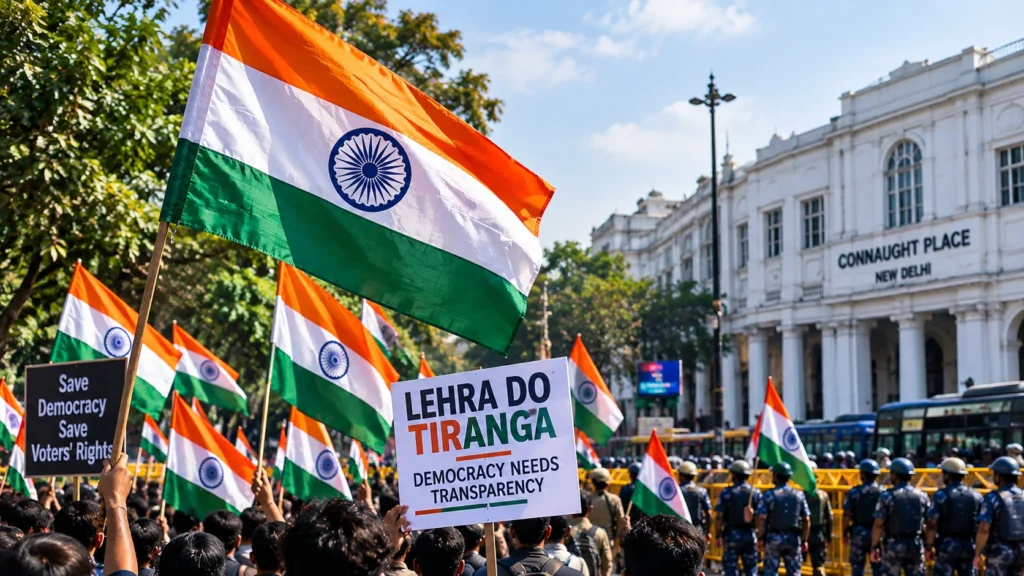
The Lehra Do Tiranga protest drew attention across New Delhi on October 16, 2026, as demonstrators gathered around Connaught Place carrying the Indian national flag. Called by the Cockroach Janta Party (CJP), the march faced heavy police security, restrictions on public gatherings and detentions, including those of CJP founder Abhijeet Dipke and student activist Neha Bora.
The Lehra Do Tiranga protest was linked to two main demands: support for CJP leaders Saurav Das and Ashutosh Ranka, who had been sent to judicial custody earlier in the week, and the resignation of Chief Election Commissioner Gyanesh Kumar over allegations concerning electoral-roll revisions.
The day’s events brought student groups, civil-society figures and political supporters into a wider debate about voting rights, election transparency and the right to peaceful protest. Reports differed on crowd size and detention numbers, so figures should be understood in the context of each report’s location and timing.
Lehra Do Tiranga Protest: What Happened in Delhi on October 16?
The main gathering was planned for 5 pm at Central Park in Connaught Place, one of Delhi’s busiest commercial areas. Organisers asked supporters to join a flag march under the slogan “Lehra Do Tiranga,” meaning “Let the Tricolour fly.” The Lehra Do Tiranga protest was intended to show solidarity with detained CJP leaders and draw attention to concerns about voter-list revisions.
Delhi Police had prohibited the planned march at Connaught Place, citing public-order concerns and the lack of required permission. The New Delhi Municipal Council also closed Central Park for October 16 and 17. Security was tightened across central Delhi before the demonstration.
The Indian Express reported that more than 25,000 police and paramilitary personnel were deployed across the New Delhi district ahead of the march. Despite restrictions, people gathered at different points around Connaught Place and Mandi House. Demonstrators carried national flags and raised slogans, while police detained people attempting to join or continue the gathering.
Reports gave different estimates of the crowd. Reuters described nearly 500 protesters assembling in different parts of Connaught Place, while other coverage described demonstrations across a wider area. These figures may reflect different locations and reporting periods rather than one agreed count. The Lehra Do Tiranga protest ended without a repeat of the larger confrontation reported during an earlier CJP demonstration, although detentions and security arrangements kept the event in the headlines.
Lehra Do Tiranga Protest in Delhi: Key Events and Demands
The Lehra Do Tiranga protest took place in New Delhi on October 16, 2026, as supporters of the Cockroach Janta Party gathered around Connaught Place carrying Indian national flags. The demonstration aimed to show solidarity with detained CJP leaders Saurav Das and Ashutosh Ranka and raise concerns about electoral-roll revisions.
During the Lehra Do Tiranga protest, police increased security and detained several demonstrators, including CJP founder Abhijeet Dipke and student activist Neha Bora, according to media reports. Protesters also demanded the resignation of Chief Election Commissioner Gyanesh Kumar over allegations concerning voter-list revisions, which the Election Commission has disputed.
The Lehra Do Tiranga protest brought wider attention to electoral transparency, voting rights and the right to peaceful assembly. While demonstrators called for greater accountability, authorities cited public-order concerns and restrictions on the planned march. Overall, the Lehra Do Tiranga protest became part of a broader debate about voter-list revisions and the handling of political demonstrations in India.
Abhijeet Dipke Detained Before the March
Abhijeet Dipke, founder of the Cockroach Janta Party, was one of the central figures in the day’s events. He had announced the flag march after CJP leaders Saurav Das and Ashutosh Ranka were detained. Ahead of the Lehra Do Tiranga protest, police served Dipke a notice prohibiting the march at Connaught Place.
The notice referred to public announcements about the gathering and concerns over public order. Dipke was detained after leaving the residence where he was staying in Delhi to travel towards the protest site. Hindustan Times reported that a video shared by CJP showed him questioning the police action and asking how stepping outside alone amounted to a violation.
His detention prevented him from leading the march as planned. CJP supporters criticised the action, arguing that their event was intended to raise public concerns through a national-flag gathering. Police maintained restrictions on the proposed demonstration. Reports described Dipke’s detention as preventive action; detention by itself does not establish guilt or amount to a criminal conviction.
The incident became one of the most widely reported developments associated with the Lehra Do Tiranga protest and increased attention on the wider campaign.
Neha Bora and Other Student Protesters Detained
Neha Bora, president of the All India Students’ Association (AISA), was another prominent figure detained on October 16. Reports said she was detained near Mandi House while attempting to reach the demonstration. AISA and other student organisations had supported the Lehra Do Tiranga protest and the wider campaign over voter-list revisions.
Their involvement showed that the movement was not limited to CJP members. Student protesters raised concerns about electoral fairness, the treatment of demonstrators and citizens’ ability to express disagreement with public institutions. Some also called for changes to the legal framework governing appointments to the Election Commission.
Bora’s detention drew attention because she was one of the visible student representatives associated with the campaign. Reports that evening also raised questions about where she had been taken. Such reports should be distinguished from a finding of wrongdoing: being detained does not, by itself, prove that a person committed an offence.
The involvement of student groups added another dimension to the Lehra Do Tiranga protest. Alongside electoral concerns, it became a debate about youth participation, public dissent and the response of law-enforcement agencies to political gatherings.
Why Were Saurav Das and Ashutosh Ranka Detained Earlier?
The immediate trigger for the October 16 march was the earlier detention of CJP leaders Saurav Das and Ashutosh Ranka. According to The Economic Times, the two men were sent to five days of judicial custody following an incident involving a protest at Jantar Mantar.
Police alleged that the men had entered restricted private property to reach the protest area and had violated conditions intended to maintain peace. Their custody followed proceedings before a Special Executive Magistrate. CJP supporters disputed the handling of the demonstration and called for further protests.
Dipke subsequently announced the Lehra Do Tiranga protest to show solidarity with the detained leaders. The earlier incident helps explain why the October 16 gathering was organised: it followed disagreements about protest locations, police restrictions and the treatment of activists.
The legal allegations against the detained leaders should be described as allegations unless established through the relevant legal process. This distinction is important when reporting on a developing political dispute.
Lehra Do Tiranga Protest and the Voter-List Controversy
Beyond the earlier detentions, the wider campaign centres on the Special Intensive Revision (SIR) of electoral rolls and allegations that eligible voters may have been wrongly removed from voter lists. Protesters have accused the Election Commission of failing to ensure a fair process and have demanded the resignation of Chief Election Commissioner Gyanesh Kumar. The Lehra Do Tiranga protest has become part of this wider debate about electoral transparency.
Some opposition leaders and activists argue that the revision could disproportionately affect vulnerable communities and weaken confidence in elections. Reuters reported that more than 130 million names had been removed from voter lists during the broader revision process. Reported reasons included deaths, relocation and people who could not be traced. That figure relates to the wider exercise and should not be presented as the number of names removed in Delhi alone.
The Election Commission has rejected allegations that the process was designed to benefit a political party. The BJP has also denied claims of electoral manipulation and argued that the opposition is using the issue to attack constitutional institutions.
The central question is whether eligible voters have been excluded incorrectly and whether procedures for checking and correcting voter records are sufficient. Individual cases need to be examined on their own evidence; a disputed deletion does not automatically prove deliberate political interference.
For protesters, the issue concerns the right to vote and public confidence in the electoral process. For election authorities, the challenge is to maintain accurate rolls while ensuring eligible citizens are not left out. Claims raised during the Lehra Do Tiranga protest should be assessed alongside official explanations, documented cases and any available correction process.
Who Supported the Movement Before October 16?
The campaign had gained support from student organisations, activists and public figures before the march. At a press conference on October 15, CJP representatives and supporters appeared alongside Supreme Court advocate Prashant Bhushan, actor and activist Prakash Raj, student activist Aishe Ghosh, Neha Bora and other representatives.
Their participation gave the campaign visibility beyond CJP itself. However, these individuals have different backgrounds and roles; appearing at a press conference should not be taken to mean that each person endorsed every demand or action associated with the movement.
The protest also attracted support from opposition groups, including people associated with the Congress-led INDIA bloc and the Aam Aadmi Party. Their involvement reflected wider political criticism of the voter-list revision and the government’s handling of the dispute.
Ruling-party leaders challenged the movement’s motives. Defence Minister Rajnath Singh accused opposition groups of pursuing a politically motivated campaign and urged them to respect the electoral mandate. Protesters rejected the suggestion that their concerns were merely political and said electoral accountability was the central issue. The Lehra Do Tiranga protest brought these competing views into a highly visible public setting.
The presence of opposition politicians does not by itself settle the allegations, just as the government’s rejection of them does not remove the need to examine evidence. A balanced account should distinguish between verified events, claims made by participants and responses from authorities.
What Did Delhi Police and the Authorities Say?
Delhi Police restricted the proposed gathering at Connaught Place, citing public-order concerns and the lack of required permission. Authorities also relied on prohibitory orders under Section 163 of the Bharatiya Nagarik Suraksha Sanhita (BNSS). The park closure and increased deployment were intended to manage the gathering and prevent disruption in a busy commercial district.
Traders in Connaught Place had also expressed concern about the effect of repeated demonstrations on businesses, particularly during the festive season. Police restrictions were presented as a public-order measure, while protesters argued that the response was excessive.
CJP and its supporters questioned why a gathering centred on the national flag could not proceed as planned. They also criticised the detention of leaders and called for accountability over police action. The Lehra Do Tiranga protest highlighted a tension that often arises during demonstrations: authorities must manage public safety while citizens have an interest in expressing peaceful dissent.
The legal conditions for holding a public gathering and the underlying allegations about electoral rolls are separate issues. Restrictions on a march do not determine whether electoral allegations are correct, and the importance of those allegations does not automatically remove the requirement to follow lawful public-order rules.
A fair assessment requires examining the grounds for police action, the treatment of those detained and the evidence concerning voter-list changes. The facts available on October 16 do not, on their own, resolve every question raised by either side.
What Happens Next After the Delhi March?
The next developments will depend on the legal status of those detained, the response of protest organisers and any further action by election authorities. Organisers may continue to call for Gyanesh Kumar’s resignation and seek greater transparency in voter-list revisions. Student organisations and opposition groups may also raise questions about the treatment of protesters and the process for correcting electoral records.
For voters, the most practical concern is whether anyone eligible to vote has been wrongly excluded and how errors can be corrected. Citizens who believe their names are missing should check official electoral records and follow the Election Commission’s prescribed correction or enrolment procedures.
The Lehra Do Tiranga protest also raises a broader question about democratic participation: how can authorities maintain public order while protecting the right to peaceful protest? That question remains relevant beyond this particular march.
The campaign’s significance will depend not only on how many people joined it, but also on what happens next with the detained leaders, the electoral-roll dispute and the demands for greater accountability. For now, the Lehra Do Tiranga protest has brought together concerns about electoral transparency, protest rights and public trust in democratic institutions.
Frequently Asked Questions
1. Why was the Lehra Do Tiranga protest held in Delhi?
The march was called by the Cockroach Janta Party to support detained leaders Saurav Das and Ashutosh Ranka and to demand Chief Election Commissioner Gyanesh Kumar’s resignation over alleged irregularities in voter-list revisions.
2. Who was detained during the October 16 protest?
CJP founder Abhijeet Dipke and AISA president Neha Bora were among those detained. Reports said around 150 people were detained during demonstrations across central Delhi by Friday evening.
3. Why were Saurav Das and Ashutosh Ranka in judicial custody?
They were sent to five days of judicial custody after an earlier incident connected with reaching a protest at Jantar Mantar. Police alleged violations involving access restrictions and conditions intended to maintain peace.
4. What is the SIR voter-list controversy?
The Special Intensive Revision is a process for reviewing electoral rolls. The controversy concerns allegations that eligible voters may have been wrongly removed. The Election Commission has rejected claims of political bias and maintains that electoral records can be corrected through the prescribed process.
5. Did the protest take place peacefully?
The October 16 march ended without a repeat of the larger confrontation reported during an earlier CJP demonstration. However, police detained numerous protesters, and the circumstances of individual detentions should be assessed using verified reporting.
Follow Khabar Khojo
Follow @officialkhabarkhojo on Instagram for breaking news, India and world updates, business, markets, technology, sports, entertainment, lifestyle and exclusive stories.
Editorial note: This article reflects reporting available on October 16, 2026. Detention counts, legal status and official statements may change. Verify subsequent developments before publication.
Also read more of such a news on our India News


More Stories
Mumbai Local Train Services Resume After 10-Hour Halt
Jio Platforms IPO 2026 Details: Why Is It Making Headlines?
SBI Customer Data Leak and Safety Measures: 5 Smart Tips