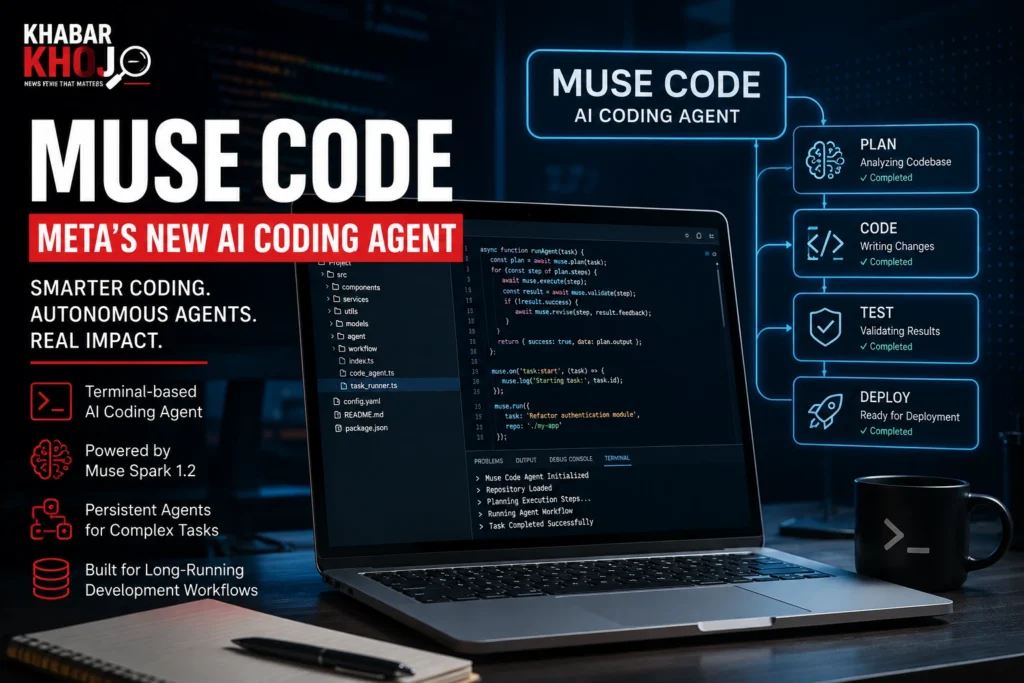
Meta has stepped further into the AI coding race with Muse Code, a new terminal-based AI coding agent designed to handle complex software-engineering tasks. Meta introduced the tool in beta on August 5, 2026, alongside its latest coding-focused model, Muse Spark 1.2.
Unlike a basic AI assistant that simply responds to programming questions or generates short code snippets, the agent is designed to work across large repositories. It can plan changes, write code and validate results as part of a longer development workflow.
The launch is another sign that AI coding tools are moving toward more autonomous software development. Meta says the agent can coordinate persistent background agents while working on difficult, multi-step tasks
Muse Code at a Glance
| Feature | Details |
|---|---|
| Tool | Muse Code |
| Company | Meta |
| Model | Muse Spark 1.2 |
| Type | AI Coding Agent |
| Launch | August 5, 2026 |
| Status | Beta |
| Platform | Terminal-based |
| Availability | macOS & Linux |
| Standard Pricing | $1.25 input / $4.25 output per 1M tokens |
| Contributor Pricing | $0.10 input / $0.20 output per 1M tokens |
| Key Feature | Persistent background agents |
| Main Use | Complex software-engineering tasks |
What Is Muse Code?
Muse Code is Meta’s new AI coding agent powered by Muse Spark 1.2. It operates through a terminal and is designed for software-engineering work across large repositories.
The agent can plan modifications, write code and validate its work instead of limiting the AI to one isolated coding response. This makes it suitable for tasks that require several stages of development.
Meta has also designed the agent to coordinate multiple persistent background agents. These agents can remain active throughout a session and help the main agent with additional work without requiring a new agent to be created for every individual task.
How Does Muse Code Work?
The core idea behind the agent is an agent-based development workflow.
A developer can give the system a software-engineering objective, after which the AI can plan the required changes, work with the repository, modify code and validate the results.
Meta says the agent uses asynchronous background agents to support the main agent. These specialized agents can continue working during a session and communicate relevant information back to the main agent when needed.
This approach is designed for longer tasks where simply generating a piece of code is not enough.
For example, a developer may need to modify several parts of an existing project, investigate an issue and verify whether the changes work correctly. The agent is built around this type of multi-step workflow.
Muse Code Uses a Persistent Activity Log
One of the more interesting technical features of the agent is its local event log.
Meta says every model call, tool run, approval and edit is added to this log. The system is designed to be restart-safe, allowing the agent to resume work after a crash instead of having to begin the task from scratch.
This is particularly important for long-running development tasks. If an AI coding session lasts for an extended period, losing its previous state could waste substantial work.
With its persistent runtime design, the agent aims to make longer autonomous coding sessions more reliable.
Muse Spark 1.2 Powers Muse Code
Behind the agent is Muse Spark 1.2, Meta’s latest coding-focused update to Muse Spark 1.1.
Meta says Muse Spark 1.2 improves areas including code generation, complex debugging, codebase understanding and end-to-end developer workflows. The company also says the model was trained extensively on long-horizon coding tasks, including whole-repository generation and large end-to-end projects.
Meta says Muse Spark 1.2 and Muse Code were co-trained to work effectively together, with the training process incorporating the Muse Code toolset and agentic coding environment.
This pairing is central to Meta’s approach: the model is not being presented as a standalone chatbot, but as the intelligence behind an agent designed to perform actual coding workflows.
What Can Muse Code Actually Do?
Muse Code is designed to work on software-engineering tasks that go beyond simple code suggestions. Meta describes it as a terminal-based coding agent that can plan changes, write code and validate its work across large repositories.
This means a developer can give the agent a broader objective instead of breaking every step into separate prompts. The agent can work through the repository, make changes and check the results as it progresses.
That approach makes the agent different from a conventional AI chatbot that mainly responds with code snippets or programming explanations.
Persistent Background Agents
A major part of the agent design is its use of persistent background agents.
Instead of creating a completely new sub-agent for every task, specialized background agents can remain active during a session. They work asynchronously and decide when their findings need to be sent back to the main agent.
For longer software projects, this can reduce repeated information gathering. The main agent can continue handling the overall task while specialized agents work on separate parts of the problem.
This is one of the features that makes the agent more focused on autonomous development rather than basic AI-assisted coding.
Built for Long-Running Work
Software development can involve tasks that take considerably longer than a normal chatbot conversation. The agent is designed around this problem.
Meta says the system uses a local event log that records model calls, tool runs, approvals and edits. This makes the runtime restart-safe, allowing work to resume after a crash instead of forcing the entire task to start again.
For developers, that could be particularly useful when an AI coding task involves many files, tools or repeated validation steps.
Pricing Has Two Tiers
One of the biggest talking points around the agent is its pricing.
The standard pay-as-you-go tier costs $1.25 per million input tokens, $0.15 per million cached input tokens and $4.25 per million output tokens. The standard tier does not use customer prompts and completions to improve Meta’s models, according to reporting on the launch.
There is also a significantly cheaper contributor tier. It costs $0.10 per million input tokens, $0.002 per million cached input tokens and $0.20 per million output tokens. The lower price comes with a data-sharing condition that allows Meta to use prompts and completions to improve its models.
That difference matters for developers working with private or commercially sensitive code. The cheaper tier should therefore not automatically be treated as the better option.
Is the AI Coding Agent Available Now?
The agent is currently available in beta, following Meta’s August 5, 2026 announcement. The tool is terminal-based and is available for macOS and Linux, according to current reporting.
Because the agent is still in beta, its capabilities and pricing details may change as Meta continues testing the product and collecting developer feedback.
The launch nevertheless puts Meta directly into a competitive AI coding-agent market alongside products from companies such as Anthropic and OpenAI.
The AI Coding Agent vs Other Coding Tools
The early comparison around the agent is not simply about which AI can write the most code. Price, long-running task support, agent architecture and performance all matter.
In Meta’s reported testing, Muse Spark 1.2 scored 82.9% on Terminal-Bench 2.1. However, these are vendor-reported comparisons and different models can be evaluated with different agent setups, so benchmark numbers should not be treated as a definitive ranking of every coding tool.
The stronger argument for the agent may therefore be its combination of coding performance, persistent agents and aggressive pricing rather than a claim that it is simply the best AI coding tool available.
What Makes the AI Coding Agent Interesting?
The most notable part of the agent is the way Meta has combined its model and coding environment.
Meta says Muse Spark 1.2 and Muse Code were co-trained together, with the training process incorporating the tools and workflows used by the coding agent.
That means Meta is attempting to optimize not just the underlying AI model, but the complete system used to perform software-engineering tasks.
For developers, the real test will be whether that combination can reliably complete difficult projects with less human intervention while maintaining code quality and security.
Is Meta’s AI Coding Agent Worth Trying?
Muse Code is an interesting release for developers who want AI to handle more than simple programming questions. Its ability to work across repositories, coordinate persistent background agents and continue long-running tasks gives it a broader role than a basic code-generation assistant.
However, the agent is still in beta. That means developers should evaluate it through real projects rather than assuming that its launch features automatically make it better than established coding agents.
For developers experimenting with AI-assisted development, the agent could be particularly useful for repository-level work, debugging and tasks that require several stages of planning and validation.
The AI Coding Agent Has a Major Privacy and Pricing Trade-Off
One of the most important details for users considering the agent is the difference between its Standard and Contributor tiers.
The Standard tier is priced at $1.25 per million input tokens and $4.25 per million output tokens, while the Contributor tier is much cheaper at $0.10 per million input tokens and $0.20 per million output tokens. Meta’s developer materials also list separate cached-input rates.
The lower Contributor pricing comes with a significant trade-off: Meta can use prompts and completions from that tier to improve its products. The Standard tier does not give Meta that same permission for customer prompts and completions.
This makes the choice important for developers handling private source code, client projects or confidential information. Users should understand the data-use terms before selecting the cheaper tier.
The AI Coding Agent Faces Strong Competition
Muse Code enters an already competitive AI coding market that includes products from major AI companies.
Meta is competing on several fronts, including repository-scale development, agent persistence and pricing. Its beta launch therefore represents more than another AI coding assistant; it is Meta’s attempt to establish its own position in AI-powered software engineering.
Meta says Muse Spark 1.2 achieved 82.9% on Terminal-Bench 2.1 in its reported evaluation. That result is notable, but benchmark scores should be viewed in context because performance can depend on the model, agent setup and evaluation methodology.
The more important test for the agent will be how reliably it performs on real developer projects.
What Are the Limitations of the AI Coding Agent?
Despite its capabilities, Muse Code should not be treated as a completely autonomous replacement for software engineers.
AI coding agents can make incorrect changes, misunderstand requirements or introduce bugs. Developers still need to inspect generated code, run tests and check security before deploying changes.
The beta status is another limitation. Meta can change features, pricing or availability as development continues.
There is also a practical consideration around cost. Token-based pricing means the final bill depends on usage, so developers working on large repositories or long-running tasks need to monitor their consumption.
Why the AI Coding Agent Matters
Muse Code is important because it reflects a broader shift in AI development tools.
The industry is moving from assistants that answer programming questions toward agents that can plan, execute and validate software-engineering work. Meta’s combination of Muse Spark 1.2 with the Muse Code environment is part of that transition.
The persistent activity log and background-agent architecture are especially relevant to long-running development tasks. Instead of treating every prompt as a separate interaction, the agent is designed to maintain an ongoing development workflow.
Frequently Asked Questions
What is Muse Code?
Muse Code is Meta’s terminal-based AI coding agent designed to help developers plan, write and validate software-engineering tasks across large code repositories.
Who developed the Code?
The Code was developed by Meta and is powered by the company’s Muse Spark 1.2 coding model
Is Muse Code free?
Muse Code is available through pay-as-you-go pricing during its beta rather than as a completely free service. Meta offers different pricing tiers for users.
What can Muse Code do?
Muse Code can help developers plan changes, write code and validate results across repositories. It can also coordinate persistent background agents for longer-running development tasks.
When was Muse Code launched?
Meta announced Muse Code on August 5, 2026, alongside Muse Spark 1.2. The AI coding agent was introduced as a beta product.
Conclusion
Muse Code marks Meta’s latest move into the rapidly growing AI coding market. Powered by Muse Spark 1.2, the new AI coding agent is designed to handle complex software-engineering workflows rather than simply generating individual code snippets.
Its repository-level capabilities, persistent background agents and long-running workflow support make Muse Code an interesting option for developers experimenting with AI-assisted programming.
However, the tool is still in beta, and developers should review, test and secure AI-generated code before using it in production. Its real success will depend on how reliably Muse Code performs on real-world projects as Meta continues developing the platform.
For more latest news, trending stories, and important updates, follow us on Instagram @officialkhabarkhojo https://instagr.am/officialkhabarkhojo and stay connected with Khabar Khojo — News that matters.
Also read more of such a news on our Internet page.




More Stories
Sheikh Ahmed bin Rashid Al Maktoum Dies at 76: Dubai in Mourning
BRICS Summit 2026 September 12: Major Decisions
Modi Putin BRICS Summit 2026: Positive Power Shift