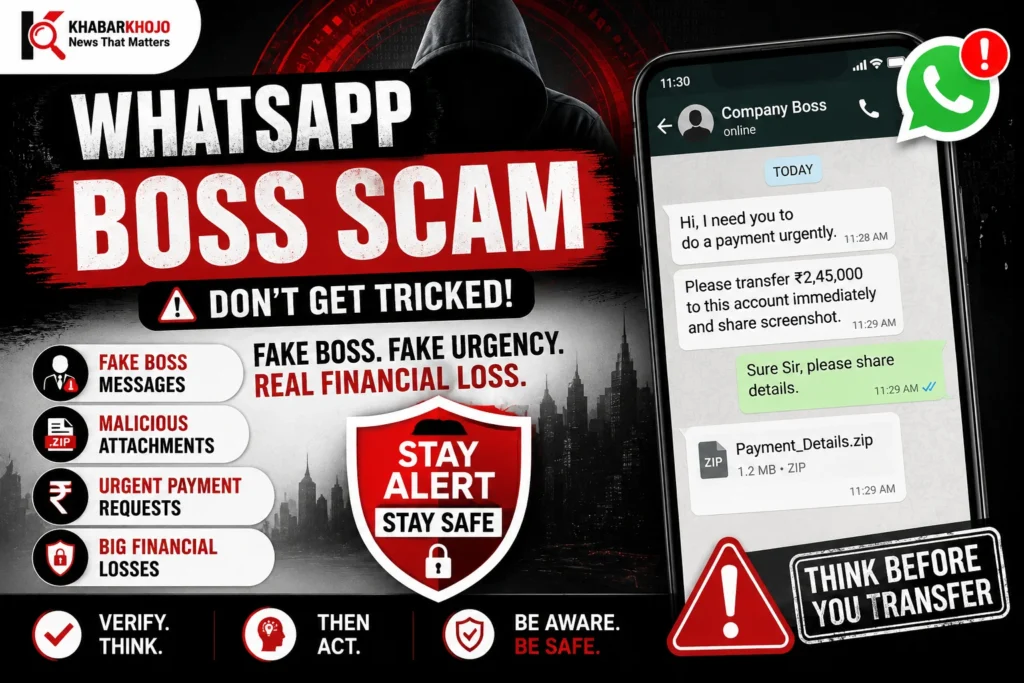
Cybercriminals are finding new ways to target employees and businesses, and the latest WhatsApp Boss Scam is a warning for anyone who receives work-related messages on WhatsApp.
In this type of fraud, scammers can impersonate a CEO, manager, director or another senior employee and use urgent messages to pressure victims into opening suspicious files or making financial transactions.
The threat is especially concerning because a message may appear to come from someone the employee already knows. India’s Computer Emergency Response Team (CERT-In) has also warned about a large-scale malware campaign targeting WhatsApp Desktop and WhatsApp Web users through malicious attachments.
If you regularly use WhatsApp for office communication, here is what you need to know about the WhatsApp Boss Scam, how it works and how you can protect yourself.
What Is the WhatsApp Boss Scam?
The WhatsApp Boss Scam is a social-engineering fraud in which cybercriminals pretend to be a senior person in a company.
The attacker may impersonate:
- A company owner
- CEO or director
- Manager
- Finance head
- HR executive
- Another senior employee
The scammer may then send an urgent message asking the employee to open a file, share information or transfer money.
The most dangerous part is the sense of trust created by the impersonation.
An employee may think:
“This message is from my boss, so I should act immediately.”
That is exactly the reaction scammers want.
How Does the WhatsApp Boss Scam Work?
The attack can involve several steps.
1. Scammers Target a Person
The attacker may first target a senior employee, executive or another person who has access to important company information.
The goal can be to gain access to a device, communication account or sensitive information.
2. A Suspicious File or Message Arrives
The victim may receive an attachment that looks like a normal business document.
It could be presented as:
- An invoice
- Compliance document
- Payment receipt
- Audit file
- Company report
- Account statement
- Security document
CERT-In has specifically advised users not to open unexpected attachments, even when they appear to come from a trusted contact.
3. Malware Can Compromise the Device
A malicious attachment can potentially install malware or provide attackers with unauthorised access.
CERT-In’s June 2026 advisory described a WhatsApp malware campaign involving malicious VBScript files sent through compromised accounts. The agency warned that successful attacks could lead to credential theft, remote access, data theft and financial losses.
4. The Attacker Impersonates a Senior Employee
Once criminals obtain access or enough information, they may impersonate a senior employee.
The victim may see the person’s familiar name or profile picture and assume the message is genuine.
5. An Urgent Payment Request Follows
The final stage can involve a request to transfer money.
The message may say that the payment needs to be completed immediately or that there is no time for the normal approval process.
This is where a simple WhatsApp conversation can turn into a major financial loss.
Why Is the WhatsApp Boss Scam Dangerous?
The WhatsApp Boss Scam is dangerous because it combines technology with psychological manipulation.
Instead of simply asking someone to click a random link, scammers try to create a believable workplace situation.
They may use:
- Familiar names
- Company information
- Urgent deadlines
- Seniority and authority
- Professional language
- Fake documents
- Pressure to act quickly
This makes the scam harder to identify than an obvious spam message.
7 Warning Signs You Should Never Ignore
1. Your Boss Suddenly Sends a ZIP File
Be extremely careful with unexpected ZIP files or executable files.
If you were not expecting the file, verify it before opening it.
2. The Message Says “Urgent”
Scammers often use urgency to prevent victims from thinking carefully.
A message saying “do this immediately” should make you more cautious, not less.
3. You Are Asked to Change Payment Details
A request to send money to a new bank account or beneficiary should always be independently verified.
4. Normal Company Procedure Is Being Skipped
If someone asks you to bypass the normal approval process because “there is no time,” stop.
5. The Message Looks Slightly Different
Watch for unusual language, spelling, strange timing or communication patterns that are different from the person’s normal behaviour.
6. You Receive an Unexpected Attachment
CERT-In recommends verifying unexpected attachments with the sender through another communication channel before opening them.
7. You Are Told Not to Tell Anyone
Requests for secrecy are another major warning sign.
If a financial transaction is legitimate, it should normally be possible to verify it through the company’s established process.
How to Stay Safe From the WhatsApp Boss Scam
The easiest way to protect yourself from the WhatsApp Boss Scam is to slow down and verify.
Verify the Person Through Another Channel
If your boss sends an unusual payment request, call them using a trusted number.
Do not rely only on the number or contact details contained in the suspicious message.
Don’t Open Unexpected Attachments
If you receive an unexpected ZIP, executable file or other suspicious attachment, don’t open it just because it came from a known contact.
CERT-In specifically recommends contacting the sender separately to confirm that the file was intentionally sent.
Keep WhatsApp and Your Devices Updated
Security updates can fix vulnerabilities and reduce the risk associated with outdated software.
CERT-In reported multiple WhatsApp vulnerabilities in 2026 and advised affected users to update to the latest available versions.
Use Strong Account Security
Use strong, unique passwords and enable available security protections such as multi-factor authentication where appropriate.
Follow Your Company’s Payment Process
Even if a request appears to come directly from a senior executive, follow the company’s normal approval procedure.
A legitimate emergency should not automatically override financial controls.
What Should Companies Do?
Businesses should not depend only on antivirus software to prevent this type of fraud.
Employee awareness is equally important.
Companies should:
- Train employees about social-engineering scams.
- Create mandatory verification procedures for urgent payments.
- Restrict unknown executable files.
- Keep operating systems and applications updated.
- Use endpoint security tools.
- Monitor suspicious account activity.
- Maintain clear financial approval procedures.
- Encourage employees to report suspicious messages immediately.
A simple rule can help:
No financial transfer should be approved only because the request arrived on WhatsApp.
What If You Already Opened a Suspicious File?
If you have already opened a suspicious attachment, don’t panic—but don’t ignore it either.
Immediately inform your company’s IT or cybersecurity team.
If appropriate under your organisation’s incident-response procedure, disconnect the affected device from the internet and avoid using it for sensitive transactions until it has been checked.
You should also preserve the suspicious message, attachment and other evidence.
If money has already been transferred because of cyber fraud, report the incident immediately through India’s official National Cyber Crime Reporting Portal and contact the cybercrime helpline 1930. The official portal provides facilities for reporting financial fraud and other cybercrimes.
You can also use the portal’s Report Suspect facility to report suspicious WhatsApp numbers, phone numbers, email IDs, website URLs and other identifiers.
WhatsApp Users Should Also Be Careful With Links
The danger isn’t limited to the WhatsApp Boss Scam.
CERT-In has also warned about WhatsApp account-takeover campaigns in which attackers trick users into linking a device to their account.
This is why users should never blindly click unexpected links or follow instructions asking them to verify, link or authenticate their WhatsApp account.
If a message looks unusual—even when it comes from a friend, colleague or manager—verify it first.
The Bottom Line
The WhatsApp Boss Scam is a reminder that cyber fraud is no longer limited to obvious spam messages.
A scam can look like a normal conversation with your manager.
A malicious file can look like a normal business document.
And a fraudulent payment request can appear to come from someone you trust.
That’s why the safest rule is simple:
Stop. Verify. Then act.
If a WhatsApp message involves an unexpected file, an urgent payment or a request to bypass normal company procedures, take a few minutes to verify it through another trusted channel.
For more technology and cyber-safety updates, you can also explore the latest stories on KhabarKhojo.
Frequently Asked Questions
What is the WhatsApp Boss Scam?
The WhatsApp Boss Scam is a type of cyber fraud where criminals impersonate senior company employees and use messages, malicious attachments or urgent payment requests to trick employees.
How can I identify the WhatsApp Boss Scam?
Look for unexpected attachments, urgent payment requests, unusual messages, new bank details, requests to bypass company procedures and pressure to keep the transaction secret.
Should I open a ZIP file sent by my boss?
Not without verification. If you weren’t expecting the file, contact your boss through another trusted channel before opening it.
What should I do if I transferred money to a scammer?
Report the financial cyber fraud immediately through the official National Cyber Crime Reporting Portal and call 1930.
Does updating WhatsApp help with security?
Yes. Keeping WhatsApp and your devices updated is an important security practice. CERT-In has published vulnerability advisories affecting WhatsApp and has advised users to install available updates.
Where can I report a suspicious WhatsApp number?
India’s National Cyber Crime Reporting Portal provides a facility to report suspicious WhatsApp numbers and other identifiers.
Official Sources
- CERT-In: Malware Campaign Spreading Through WhatsApp Attachments
- CERT-In: Multiple Vulnerabilities in WhatsApp
- National Cyber Crime Reporting Portal
“Thanks for reading! Stay updated with KhabarKhojo for the latest news and updates.”




More Stories
500000 Fake Gmail Accounts in India: Shocking India Case
iPhone 18 Launch: Exciting Apple Reveal With Powerful New Features
Ahmedabad Fake Liquor Sold in Expensive Bottles: Police Bust Counterfeit Liquor Racket