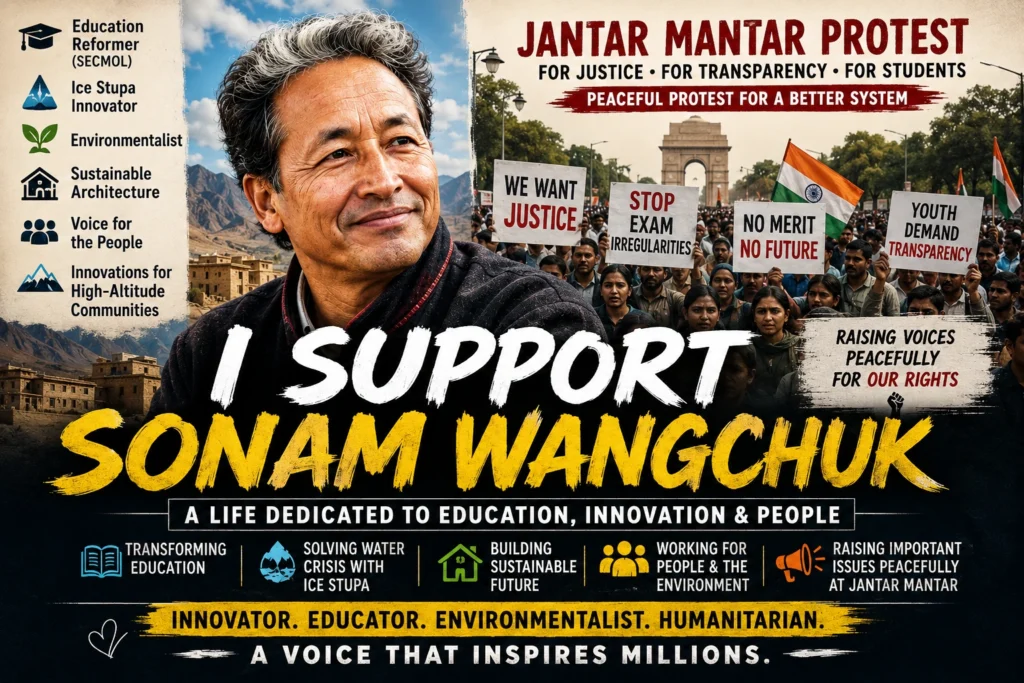
Sonam Wangchuk: The Man Who Dedicated His Life to India and Ladakh
Introduction
There are very few people who dedicate their entire lives to solving real problems instead of simply talking about them. Sonam Wangchuk is one of those rare individuals. Known as an engineer, education reformer, innovator, and environmentalist, Wangchuk has spent more than three decades working to improve the lives of people living in Ladakh’s harsh Himalayan region. His efforts have not only transformed education and sustainable development in Ladakh but have also inspired millions across India and around the world.
Unlike many innovators who work only in laboratories or corporate offices, Sonam Wangchuk chose to work directly with communities facing some of the country’s toughest challenges. Whether it is helping students receive a better education, finding solutions to water shortages, promoting eco-friendly architecture, or developing technologies suitable for high-altitude regions, his work has consistently focused on practical solutions that can improve everyday lives.
His contributions have earned him prestigious national and international awards, including the Ramon Magsaysay Award, often regarded as Asia’s equivalent of the Nobel Prize. Over the years, his innovations have been studied by engineers, environmentalists, policymakers, and educational institutions worldwide.
In recent years, Sonam Wangchuk has also become one of the most recognized voices speaking about the future of Ladakh. Through peaceful campaigns and public initiatives, he has continued to raise awareness about environmental conservation, sustainable development, and the concerns of local communities. While opinions on public issues may differ, there is broad recognition that his decades of work in education, innovation, and environmental protection have made a lasting impact.
This article explores the remarkable journey of Sonam Wangchuk, the innovations that changed lives, his contributions to India and Ladakh, and why his work continues to earn respect from people across the country.
Early Life: A Childhood That Inspired Sonam Wangchuk’s Mission
Sonam Wangchuk was born on 1 September 1966 in Alchi, a small village in Ladakh, where life has always been shaped by extreme weather, rugged mountains, and limited resources. Growing up in such an environment taught him that survival often depends on creativity, cooperation, and making the best use of what is available.
His educational journey was far from ordinary. Until the age of nine, he did not attend a formal school because suitable educational facilities were not easily accessible in his village. Instead, his mother became his first teacher, educating him in his native language while helping him develop a strong foundation in learning.
When he eventually entered the formal education system, he faced another challenge. Most schools relied on languages and teaching methods that many Ladakhi children struggled to understand. This experience left a deep impression on him and later became one of the strongest reasons behind his mission to reform education in Ladakh.
Rather than accepting these problems as inevitable, Wangchuk began questioning why education could not be designed around the needs of local students. That question would eventually shape the direction of his entire career.
After completing his schooling, he pursued engineering at the Regional Engineering College (REC), Srinagar, now known as the National Institute of Technology (NIT) Srinagar, graduating in 1987. While engineering gave him technical knowledge, he also developed a deep interest in sustainable development and later expanded his understanding of earthen architecture through studies in France.
These experiences helped him combine modern engineering with traditional Himalayan wisdom—an approach that would become the hallmark of almost every project he later undertook.
How Sonam Wangchuk Began Transforming Education in Ladakh
Soon after completing his engineering studies, Sonam Wangchuk made a decision that surprised many people. Instead of pursuing a high-paying corporate career, he returned to Ladakh with a vision to improve education for future generations.
In 1988, he co-founded the Students’ Educational and Cultural Movement of Ladakh (SECMOL), an organization that would go on to become one of India’s most respected education reform initiatives.
At that time, thousands of students in Ladakh were struggling in the conventional education system. High failure rates were common, and many children were unfairly labeled as weak students. Wangchuk believed the real problem was not the children but an education system that failed to reflect Ladakh’s language, culture, environment, and way of life.
SECMOL introduced a completely different approach to learning.
Instead of focusing only on textbooks and examinations, students were encouraged to:
- Learn through practical experience.
- Develop leadership and decision-making skills.
- Solve real-life community problems.
- Build confidence through responsibility.
- Understand science by applying it in everyday situations.
The campus itself became a living classroom where students actively participated in farming, construction, renewable energy projects, and community management.
This model demonstrated that education could be meaningful, practical, and closely connected to local realities rather than limited to memorizing information for examinations.
Over the years, SECMOL attracted visitors from across India and abroad, including educators, researchers, policymakers, and students interested in learning from its innovative approach.
For many people, this was the beginning of Sonam Wangchuk’s journey as one of India’s most influential education reformers.
SECMOL: More Than Just a School
What makes SECMOL truly unique is that it is far more than an educational institution.
The campus operates as a model of self-reliance and sustainability, where students are encouraged to take responsibility for daily operations while learning valuable life skills.
Many of its buildings are constructed using locally available materials and designed to remain warm during Ladakh’s freezing winters without depending heavily on conventional heating systems. Solar energy powers much of the campus, reducing both costs and environmental impact.
Students are not only taught academic subjects but are also encouraged to become innovators capable of solving challenges within their own communities.
This philosophy has inspired educators from different parts of India to rethink traditional teaching methods and consider how education can better prepare students for real-world challenges.
For Sonam Wangchuk, education has never been about producing high examination scores alone. Instead, it has always been about developing individuals who can think independently, serve society, and create practical solutions for the future.
How the Ice Stupa Became Sonam Wangchuk’s Most Famous Innovation
Among all of Sonam Wangchuk’s contributions, the Ice Stupa is perhaps the innovation that brought him global recognition. While many people know it as an artificial glacier, its real purpose is much more significant—it is a practical solution to one of Ladakh’s biggest challenges: water scarcity.
In the Himalayan region, winters are extremely cold and water remains frozen for months. However, when spring arrives and farmers need water the most for sowing crops, natural glaciers often have not melted enough to provide sufficient irrigation. This mismatch between water availability and agricultural needs created serious difficulties for villages across Ladakh.
Instead of accepting the problem as unavoidable, Wangchuk searched for a solution that would work with nature rather than against it.
In 2014, he and his team introduced the first Ice Stupa—a cone-shaped tower of ice created by spraying winter stream water into freezing temperatures. The cone shape allows the ice to melt much more slowly than flat sheets of ice, ensuring that water becomes available during the crucial spring months.
What makes this innovation remarkable is its simplicity. It does not depend on expensive machinery or large dams. Instead, it uses gravity, natural winter temperatures, and local engineering to store water that would otherwise flow away unused.
Over time, the Ice Stupa project gained international attention. Researchers, environmental organizations, and governments began studying the idea as an example of how local innovation can help communities adapt to climate change. Similar projects have even been explored outside India, including in parts of Europe such as the Swiss Alps.
For many people, the Ice Stupa is more than an engineering achievement—it represents Sonam Wangchuk’s belief that some of the world’s biggest challenges can be addressed through simple, community-driven solutions.
Building Sustainable Architecture for the Himalayas
Long before sustainable construction became a global trend, Sonam Wangchuk was already demonstrating how traditional Himalayan knowledge could work alongside modern engineering.
The buildings at the SECMOL campus are among the best examples of this philosophy.
Constructed using rammed earth, mud, stone, and other locally available materials, these buildings are designed to remain warm during Ladakh’s freezing winters while staying cool in summer. Instead of relying heavily on fossil fuels, they use passive solar architecture, where sunlight is captured and stored naturally to heat indoor spaces.
This approach significantly reduces energy consumption and makes construction more affordable for remote mountain communities.
One of SECMOL’s most notable structures, often referred to as the “Big Building,” received international recognition through the International Terra Award for its innovative use of earthen architecture.
The project demonstrated that environmentally friendly buildings can also be durable, comfortable, and cost-effective. Rather than replacing traditional knowledge, Wangchuk’s designs modernized it for contemporary needs.
His work has inspired architects, engineers, and sustainability experts from across the world to study how local materials and climate-responsive designs can reduce environmental impact while improving quality of life.
Innovation for India’s High-Altitude Regions and Soldiers
Sonam Wangchuk’s work has never been limited to classrooms or environmental projects. He has also explored practical technologies that could benefit people living and working in some of the harshest climates on Earth.
One of his notable innovations involved solar-heated mobile shelters designed for use in high-altitude regions. These shelters were developed to capture heat during the day and retain warmth at night, helping reduce dependence on conventional fuel sources in freezing conditions.
Such ideas highlighted how renewable energy and smart design could improve living conditions in mountainous areas where temperatures often fall well below freezing.
Beyond housing solutions, Wangchuk has also applied engineering techniques to address environmental risks in the Himalayas. His work on draining potentially dangerous glacial lakes using simple siphon-based methods demonstrated how low-cost engineering can help reduce the risk of glacier-related flooding.
These innovations reflect a recurring theme throughout his career: solving complex problems with practical, affordable, and locally adaptable solutions rather than relying solely on expensive infrastructure.
The Himalayan Institute of Alternatives (HIAL): Rethinking Higher Education
After transforming school-level education through SECMOL, Sonam Wangchuk turned his attention toward higher education.
He believed that universities in mountain regions should prepare students for the realities of their environment rather than encouraging them to leave in search of opportunities elsewhere.
With this vision, he founded the Himalayan Institute of Alternatives, Ladakh (HIAL).
The institution promotes an approach often summarized as “the right education for the right place.” Instead of focusing only on conventional academic degrees, HIAL encourages students to work on practical challenges related to mountain ecosystems, renewable energy, sustainable tourism, agriculture, water management, and local entrepreneurship.
The goal is to help young people become innovators who contribute directly to the development of Himalayan communities.
By combining classroom learning with hands-on projects, HIAL continues Wangchuk’s long-standing belief that education should equip students to solve real problems, not just pass examinations.
Supporting Local Communities Through Sustainable Tourism
Sonam Wangchuk has also worked to ensure that economic development benefits local communities.
In 2016, he helped launch FarmStays Ladakh, an initiative that encourages tourists to stay with local families rather than relying only on hotels.
The idea creates additional income for rural households while allowing visitors to experience Ladakhi culture, traditions, and daily life more closely.
The initiative has particularly benefited women and small farming families by providing new livelihood opportunities linked to responsible tourism.
Rather than promoting rapid commercial development, Wangchuk has consistently advocated for tourism that respects the fragile Himalayan environment while strengthening local economies.
A Philosophy Built on Practical Solutions
Across education, architecture, water conservation, renewable energy, and community development, one principle connects Sonam Wangchuk’s work.
He has consistently focused on finding practical solutions instead of waiting for ideal conditions.
Whether designing an artificial glacier, creating energy-efficient buildings, improving educational systems, or supporting local entrepreneurship, his projects demonstrate how innovation can emerge from understanding local challenges.
Supporters often point to this practical approach as one of the defining characteristics of his work. Instead of presenting ideas only in theory, many of his initiatives have been implemented, tested, and adapted in real communities.
For this reason, Sonam Wangchuk is widely regarded not only as an innovator but also as someone whose work has encouraged conversations about sustainability, education, and development far beyond Ladakh.
Recognition, Public Service and the Latest Developments
National and International Recognition
Over the years, Sonam Wangchuk’s work has received recognition not only in India but across the world. What makes these awards significant is that they acknowledge practical innovations that have directly benefited communities rather than theoretical research alone.
One of the biggest milestones in his career came in 2018, when he received the Ramon Magsaysay Award, often regarded as Asia’s highest civilian honour. The award recognized his efforts to transform education in Ladakh and empower young people through practical learning.
Before that, he received the Rolex Award for Enterprise (2016) for the Ice Stupa project, which demonstrated an innovative way to address water shortages in cold desert regions.
His sustainable construction techniques also earned him the Global Award for Sustainable Architecture (2017), recognizing his work in designing environmentally friendly buildings suited to Himalayan conditions.
Apart from these international honours, Wangchuk has also received the Ashoka Fellowship, the Real Heroes Award, and several national and international recognitions for social innovation, renewable energy, and environmental conservation.
These awards reflect how his work has influenced educators, architects, engineers, climate researchers, and policymakers around the world.
A Voice for Ladakh’s Future
In recent years, Sonam Wangchuk has become one of the most prominent public voices speaking about Ladakh’s future.
He has repeatedly highlighted concerns related to environmental conservation, sustainable development, protection of fragile Himalayan ecosystems, and the long-term interests of local communities.
His campaigns have focused on constitutional safeguards, ecological protection, and responsible development in the region. These efforts have sparked nationwide discussions about balancing economic growth with environmental preservation.
Throughout these campaigns, Wangchuk has consistently advocated peaceful methods such as public awareness drives, dialogue, marches, and hunger strikes to express his views.
Regardless of differing political opinions, his role has brought greater national attention to Ladakh and the environmental challenges facing the Himalayan region.
Latest 2026 Developments
In 2026, Sonam Wangchuk once again returned to national headlines after joining public demonstrations at Jantar Mantar in New Delhi.
He began an indefinite hunger strike in support of demands related to alleged examination irregularities and broader public concerns. As the fast continued, doctors monitoring his health reported noticeable weight loss and warned that prolonged fasting could increase medical risks.
The matter also reached the Delhi High Court, which directed authorities to ensure that Wangchuk receives daily medical monitoring, emphasizing that every citizen’s life is precious and appropriate medical care should be available whenever necessary.
His protest has received support from several citizens and public figures, while authorities have continued to respond through legal and administrative processes. The developments remain ongoing.
The Legacy of Sonam Wangchuk
What distinguishes Sonam Wangchuk from many innovators is his focus on solving problems at the grassroots level.
Instead of waiting for ideal conditions, he has spent decades developing practical ideas that communities can use immediately. Whether through improving education, conserving water, designing sustainable buildings, or encouraging responsible development in mountain regions, his projects have consistently aimed to improve everyday life.
His work demonstrates that innovation does not always require expensive technology. Sometimes, understanding local conditions and applying simple scientific principles can create solutions with lasting impact.
For many educators, engineers, environmentalists, and young innovators, Wangchuk’s journey serves as an example of how knowledge can be used to address real-world challenges while remaining closely connected to local communities.
Frequently Asked Questions (FAQs)
Who is Sonam Wangchuk?
Sonam Wangchuk is an Indian engineer, innovator, education reformer, and environmentalist from Ladakh. He is the founder of SECMOL and the creator of the Ice Stupa project.
What is the Ice Stupa?
The Ice Stupa is an artificial glacier that stores winter water as ice and releases it during spring to help farmers facing water shortages.
What awards has Sonam Wangchuk received?
His major honors include the Ramon Magsaysay Award (2018), Rolex Award for Enterprise (2016), Global Award for Sustainable Architecture (2017), Ashoka Fellowship, and several other national and international recognitions.
What is SECMOL?
SECMOL (Students’ Educational and Cultural Movement of Ladakh) is an educational organization founded in 1988 that promotes practical learning, leadership, and locally relevant education.
Conclusion
For more than three decades, Sonam Wangchuk has dedicated himself to improving education, promoting sustainable development, and finding innovative solutions to the unique challenges faced by Himalayan communities.
From establishing SECMOL and rethinking education in Ladakh to developing the globally recognized Ice Stupa, designing energy-efficient buildings, supporting sustainable livelihoods, and encouraging environmentally responsible development, his work has had a lasting impact on thousands of lives.
His recent public campaigns have once again brought him into the national spotlight, but regardless of differing opinions on current issues, his long record of contributions to education, innovation, and environmental conservation continues to be widely recognized.
His journey shows how determination, scientific thinking, and community participation can work together to address some of society’s most complex challenges
Follow Khabar Khojo
Stay informed with Khabar Khojo – News That Matters, where we bring you verified news, in-depth explainers, fact-based analysis, and the latest updates from India and around the world.
📲 Follow us on Instagram: @officialkhabarkhojo https://instagr.am/officialkhabarkhojo
Also read more of such a blog on our India News
Sources
- Sonam Wangchuk – Wikipedia – Biography, education, SECMOL, Ice Stupa, awards, and career overview.
- HIAL (Himalayan Institute of Alternatives, Ladakh) – Official website for the Himalayan Institute of Alternatives.
- Reuters: Sonam Wangchuk Hunger Strike Update (July 2026) – Latest verified update on his hunger strike and Delhi High Court directions.
- The Times of India: Health Update & Delhi HC Order – Latest developments regarding his health and court proceedings.
- The Times of India: Jantar Mantar Protest Update – Coverage of the ongoing protest and Parliament march announcement.

More Stories
Dharmendra Pradhan Resignation 2026: Education Minister Quits After Massive NEET-UG Protest Movement
India News July 2026: Top Updates From the Last 24 Hours Amid Chaos, Plus Kashmir Security Update
Chalo Sansad Protest 2026: Massive 50,000+ Protesters Rally Over NEET Paper Leak, Police Use Lathi-Charge and Tear Gas