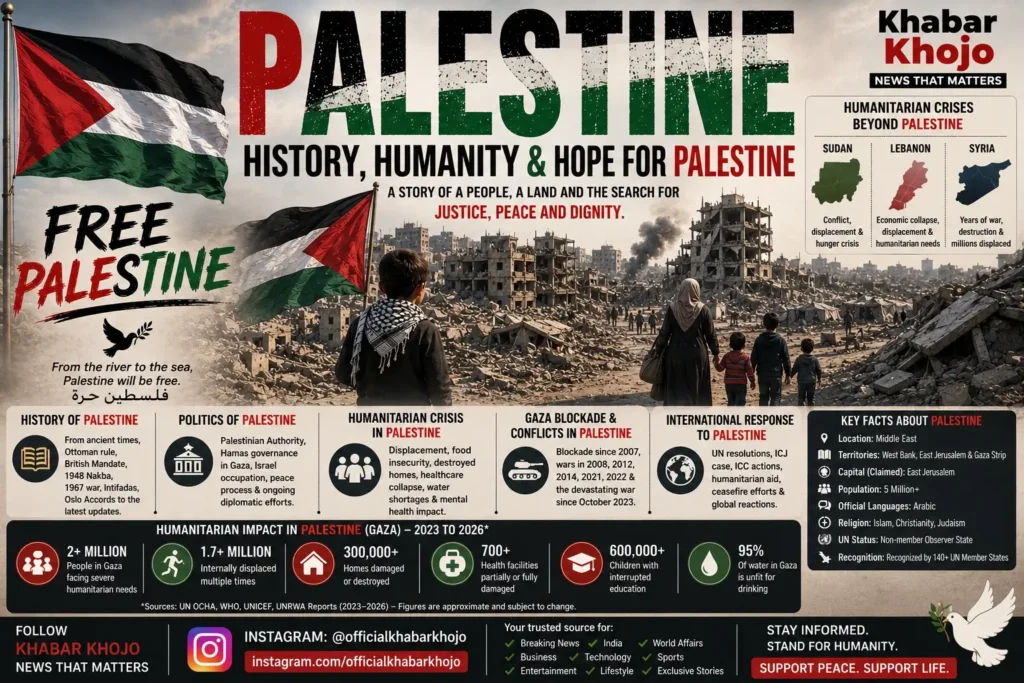
An overview of Palestine's history, humanitarian situation, and international response through 2026.
For decades, Palestine has remained one of the world’s most discussed regions, attracting global attention due to its historical importance, political disputes, humanitarian crisis, and ongoing conflict. Millions of people across the world closely follow developments in Palestine because the situation affects not only the Middle East but also international diplomacy, humanitarian aid, and global security.
The modern story of Palestine is much more than a political dispute. It is also a story of families displaced from their homes, communities trying to rebuild after repeated destruction, children growing up amid conflict, and continuous efforts by international organizations to provide humanitarian assistance. At the same time, it is a region that holds profound religious, cultural, and historical significance for Muslims, Christians, and Jews alike.
This guide explains the history of Palestine, how the current situation developed, the humanitarian impact on civilians, the latest developments, and why the issue continues to remain one of the world’s most debated international topics.
Background of Palestine
Palestine is a historic region located along the eastern Mediterranean coast. Today, the term generally refers to the West Bank, including East Jerusalem, and the Gaza Strip, territories internationally associated with the Palestinian people.
For thousands of years, Palestine has been home to diverse civilizations, empires, and religious communities. Because of its location and religious importance, control of the region has changed many times throughout history.
Today, Palestine remains partially governed by different Palestinian authorities while much of the territory remains affected by the broader Israeli–Palestinian conflict. The political status of Palestine continues to be the subject of international negotiations, diplomatic recognition, and legal debate.
Why Is Palestine Important?
Palestine holds exceptional importance for several reasons.
Religious Importance
Jerusalem contains some of the holiest religious sites in the world.
For Muslims:
- Al-Aqsa Mosque
- Dome of the Rock
For Christians:
- Church of the Holy Sepulchre
For Jews:
- Western Wall
Because these sacred places are located within the same historic city, Jerusalem remains central to religious, political, and diplomatic discussions.
Historical Importance
The region has witnessed thousands of years of human civilization.
It has been ruled by numerous empires including:
- Ancient Canaanite kingdoms
- Assyrian Empire
- Babylonian Empire
- Persian Empire
- Greek Empire
- Roman Empire
- Byzantine Empire
- Islamic Caliphates
- Ottoman Empire
- British Mandate Administration
Each period has shaped the region’s culture, architecture, languages, and demographics.
Political Importance
The question of Palestinian statehood remains one of the longest unresolved political issues in modern international relations.
Many countries recognize the State of Palestine, while others support a negotiated two-state solution. International organizations including the United Nations continue to discuss issues relating to borders, security, refugees, settlements, and humanitarian access.
Ancient History of Palestine
Archaeological evidence suggests that people have lived in the region for thousands of years.
Ancient cities such as:
- Jericho
- Hebron
- Jerusalem
- Gaza
are among the oldest continuously inhabited places on Earth.
The area became an important crossroads connecting Africa, Asia, and Europe, making it valuable for trade and military campaigns.
Throughout ancient history, many civilizations settled in Palestine, leaving behind temples, roads, forts, manuscripts, and archaeological sites that continue to be studied today.
Palestine During the Ottoman Empire
Beginning in the early 16th century, Palestine became part of the Ottoman Empire.
For approximately four centuries, the Ottoman administration governed the region through local districts.
During this period:
- Agriculture expanded.
- Cities such as Jerusalem, Jaffa, Nablus, and Gaza developed.
- Muslim, Christian, and Jewish communities lived throughout the region.
- Religious sites continued attracting pilgrims from around the world.
Although the Ottoman Empire experienced periods of stability, it gradually weakened during the 19th century.
British Mandate and the Beginning of Modern Political Conflict
Following the defeat of the Ottoman Empire during World War I, Britain assumed administrative control over Palestine under the League of Nations Mandate system.
This period fundamentally changed the region’s political landscape.
Several developments occurred simultaneously:
- Growth of Arab nationalism.
- Increased Jewish immigration.
- Rising political tensions.
- Land ownership disputes.
- British administrative reforms.
- Violent clashes between communities.
One of the most influential documents during this period was the 1917 Balfour Declaration, in which the British government expressed support for establishing a “national home for the Jewish people” in Palestine while also stating that the civil and religious rights of existing non-Jewish communities should not be prejudiced.
Different communities interpreted this declaration in different ways, contributing to increasing tensions throughout the following decades.
The End of the British Mandate
By the mid-1940s, violence between different armed groups had intensified.
Britain announced its intention to end the Mandate and referred the issue to the newly established United Nations.
In 1947, the UN proposed a partition plan recommending separate Jewish and Arab states with a special international status for Jerusalem.
The proposal was accepted by many Jewish leaders but rejected by many Arab leaders, who argued that it did not fairly represent the Arab population living in Palestine at the time.
The disagreement over the partition plan set the stage for the events that followed in 1948, changing the lives of millions of people across the region.
Quick Facts About Palestine
| Fact | Information |
|---|---|
| Region | Middle East |
| Main Territories | West Bank and Gaza Strip |
| Capital Claimed by Palestinians | East Jerusalem |
| Primary Language | Arabic |
| Currency Commonly Used | Israeli New Shekel (NIS) and Jordanian Dinar in some areas |
| Religion | Islam, Christianity, Judaism |
| Major Humanitarian Agencies | UNRWA, ICRC, WHO, UNICEF, OCHA |
Palestine History (1947–2005): The Nakba, Occupation, Intifadas & Peace Efforts
The 1947 United Nations Partition Plan
After years of increasing tensions during the British Mandate, Britain referred the question of Palestine to the newly established United Nations. On 29 November 1947, the UN General Assembly adopted Resolution 181, commonly known as the UN Partition Plan.
The proposal recommended dividing Mandatory Palestine into two independent states:
- A Jewish state.
- An Arab state.
- Jerusalem and its surrounding area would be placed under international administration because of its religious significance.
Many Jewish leaders accepted the proposal as a basis for establishing a state, while many Arab leaders rejected it, arguing that it did not fairly reflect the wishes and demographic distribution of the Arab population living in Palestine at the time. The disagreement led to escalating violence even before the British Mandate formally ended.
The 1948 Arab–Israeli War
On 14 May 1948, the State of Israel declared independence. The following day, forces from several neighboring Arab countries entered the conflict, marking the beginning of the 1948 Arab–Israeli War.
The war resulted in significant territorial changes, heavy casualties, and large-scale displacement. By the time fighting ended through armistice agreements in 1949, Israel controlled more territory than had been proposed under the UN Partition Plan. The West Bank came under Jordanian administration, while Egypt administered the Gaza Strip.
The conflict remains a defining event in the history of both Israelis and Palestinians, with each community remembering it through different historical narratives.
The Nakba: A Defining Moment for Palestinians
For Palestinians, the events surrounding the 1948 war are widely referred to as the Nakba, meaning “catastrophe” in Arabic.
During and after the war, an estimated 700,000 or more Palestinians were displaced or fled from their homes, according to numerous historical studies and United Nations records. Hundreds of villages were depopulated or destroyed, and many families were unable to return after the conflict ended.
The Nakba continues to shape Palestinian identity and remains central to discussions about refugees, property rights, and the right of return. Many Palestinian families today still preserve documents, photographs, and keys to homes from which they or their ancestors were displaced.
The Palestinian Refugee Crisis
The displacement of Palestinians during and after the 1948 war created one of the world’s longest-running refugee situations.
Many refugees settled in:
- Gaza Strip
- West Bank
- Jordan
- Lebanon
- Syria
Over time, refugee camps established as temporary shelters developed into densely populated communities. The United Nations Relief and Works Agency for Palestine Refugees in the Near East (UNRWA) was established in 1949 to provide education, healthcare, emergency assistance, and social services to registered Palestinian refugees.
Today, millions of registered Palestinian refugees and their descendants continue to receive services from UNRWA across the region.
Life in Refugee Camps
Although many refugee camps have evolved into permanent neighborhoods, residents often face significant social and economic challenges.
Common issues documented by humanitarian organizations include:
- Overcrowded housing.
- Limited employment opportunities.
- Pressure on schools and healthcare facilities.
- Inadequate infrastructure in some camps.
- Dependence on humanitarian assistance.
Conditions vary widely between camps and countries, but the refugee issue remains one of the most important unresolved aspects of the Israeli–Palestinian conflict.
The 1967 Six-Day War
In June 1967, Israel fought Egypt, Jordan, and Syria in what became known as the Six-Day War.
At the end of the conflict, Israel gained control of:
- The West Bank.
- East Jerusalem.
- Gaza Strip.
- Sinai Peninsula.
- Golan Heights.
The capture of the West Bank, East Jerusalem, and Gaza had long-term consequences for Palestinians and remains central to international diplomacy.
Following the war, many Palestinians experienced another wave of displacement, while those remaining in the occupied territories faced a new political and administrative reality.
Israeli Occupation of the West Bank and Gaza
Following the 1967 war, Israel established military administration over the West Bank and Gaza. Over subsequent decades, Israeli settlements were built in parts of the occupied territories, a policy viewed by much of the international community as contrary to international law, while Israel disputes aspects of that legal interpretation and cites historical, security, and legal arguments in support of its positions.
For many Palestinians, daily life under occupation has involved a range of challenges, including:
- Military checkpoints affecting movement.
- Permit systems for travel and employment.
- Restrictions in certain areas.
- Land and property disputes.
- Security operations.
- Periodic outbreaks of violence.
Israeli authorities state that many security measures are intended to prevent attacks against civilians, while critics argue that these measures have imposed significant humanitarian and economic burdens on Palestinians.
United Nations Resolution 242
Following the Six-Day War, the UN Security Council adopted Resolution 242 in November 1967.
The resolution called for:
- Withdrawal of Israeli armed forces “from territories occupied in the recent conflict” (language that has been interpreted differently by various parties).
- Recognition of every state’s right to live in peace within secure and recognized boundaries.
- A just settlement of the refugee issue.
Resolution 242 has remained a key reference point in peace negotiations for decades.
Palestinian National Movement
During the late 1960s and 1970s, the Palestine Liberation Organization (PLO) became the principal representative body for many Palestinians.
Led for many years by Yasser Arafat, the PLO sought international recognition of Palestinian national aspirations. Over time, the organization shifted from primarily armed struggle toward diplomacy and negotiations, particularly from the late 1980s onward.
The First Intifada (1987–1993)
In December 1987, a widespread Palestinian uprising known as the First Intifada began in the occupied territories.
The movement included:
- Demonstrations.
- Civil disobedience.
- General strikes.
- Boycotts.
- Stone-throwing by some protesters.
- Armed clashes in certain instances.
Israel responded with military and police measures to restore order. The period saw casualties among both Palestinians and Israelis and drew significant international attention.
The First Intifada highlighted longstanding grievances regarding occupation and contributed to renewed diplomatic efforts.
The Oslo Accords
In 1993, Israel and the PLO signed the Oslo Accords, marking the first mutual recognition between the two sides.
The agreements established the Palestinian Authority (PA) to administer parts of the West Bank and Gaza and outlined a framework for further negotiations on key issues such as borders, refugees, settlements, security, and Jerusalem.
Many viewed the accords as a major step toward peace, though many core issues were left unresolved. Subsequent negotiations faced repeated setbacks.
The Second Intifada (2000–2005)
The Second Intifada began in late 2000 amid rising tensions after the collapse of peace talks and other political developments.
Compared with the First Intifada, this period involved more intense violence, including:
- Armed confrontations.
- Suicide bombings targeting Israeli civilians.
- Israeli military operations.
- Airstrikes.
- Curfews.
- Extensive damage to infrastructure.
Thousands of Palestinians and Israelis were killed during the conflict. The violence had profound humanitarian, social, and economic consequences for communities on both sides.
Israel’s Withdrawal from Gaza (2005)
In 2005, Israel implemented a unilateral disengagement plan, withdrawing its military forces and evacuating Israeli settlements from the Gaza Strip.
Although Israeli forces left Gaza, Israel continued to control its airspace, maritime access, and most border crossings (with Egypt controlling the Rafah crossing under varying arrangements over time). The legal and political implications of Gaza’s status remain the subject of international debate.
Following the withdrawal, Palestinian politics underwent significant changes that would shape developments in the years ahead.
Key Takeaways
- The 1948 war and the Nakba remain foundational events in Palestinian history.
- The Palestinian refugee issue continues to affect millions across the Middle East.
- The 1967 Six-Day War reshaped territorial control and the political landscape.
- The Oslo Accords created the Palestinian Authority but did not resolve core disputes.
- The First and Second Intifadas profoundly affected both Palestinian and Israeli societies.
- By 2005, the conflict had entered a new phase that would lead to further political divisions and recurring cycles of conflict.
Palestine History (2006–2022): Political Division, Gaza Blockade, Humanitarian Crisis & International Response
A New Political Era After 2005
Israel’s 2005 withdrawal from the Gaza Strip marked the beginning of a new chapter, but it did not end the Israeli–Palestinian conflict. Instead, political divisions among Palestinians, changes in governance, and repeated outbreaks of violence shaped the years that followed.
The period from 2006 to 2022 saw major political changes, armed conflicts, humanitarian emergencies, and increasing international concern over the lives of civilians.
The 2006 Palestinian Legislative Elections
In January 2006, Palestinians held legislative elections for the Palestinian Legislative Council.
The political movement Hamas won a majority of seats, defeating the long-dominant Fatah party.
The election was widely regarded by international observers as generally free and competitive. However, the outcome led to political disagreements both within Palestinian politics and internationally.
Many countries, including the United States and members of the European Union, maintained restrictions on dealings with Hamas because they designate it as a terrorist organization.
The election results created a political crisis that eventually divided Palestinian governance.
The Split Between Gaza and the West Bank
In 2007, tensions between Hamas and Fatah escalated into armed clashes.
After several days of fighting:
- Hamas took control of the Gaza Strip.
- The Palestinian Authority, dominated by Fatah, continued governing parts of the West Bank.
Since then:
Gaza
- Governed by Hamas.
West Bank
- Administered by the Palestinian Authority in areas under its control, alongside continued Israeli military occupation in much of the territory.
This political division continues today and has complicated peace negotiations and governance.
The Gaza Blockade
Following Hamas’ takeover of Gaza in 2007, Israel imposed a blockade on the Gaza Strip, citing security concerns and the need to prevent weapons from reaching Hamas. Egypt also imposed restrictions on its border with Gaza at different times, particularly through the Rafah crossing.
Israeli authorities state that these measures are intended to reduce security threats and attacks against Israeli civilians.
Humanitarian organizations, including the United Nations and the International Committee of the Red Cross, have said the blockade has had severe humanitarian and economic consequences for Gaza’s civilian population.
The blockade has affected:
- Imports and exports.
- Freedom of movement.
- Employment.
- Access to construction materials.
- Healthcare referrals.
- Economic development.
The impact of the blockade remains a major point of international debate.
Living Conditions in Gaza
The Gaza Strip is one of the most densely populated areas in the world.
Years of conflict, political isolation, and economic restrictions have affected daily life for many residents.
According to UN agencies, recurring challenges have included:
- High unemployment.
- Electricity shortages.
- Limited clean drinking water.
- Pressure on hospitals.
- Damage to infrastructure.
- Housing shortages.
- Limited economic opportunities.
Humanitarian organizations have repeatedly warned that prolonged conflict and restrictions have made living conditions increasingly difficult for many civilians.
Major Conflicts Between Israel and Armed Groups in Gaza
Since 2008, Gaza has experienced several major rounds of fighting between Israel and Palestinian armed groups, particularly Hamas and Islamic Jihad.
These conflicts have typically involved:
- Rocket fire toward Israel by armed groups.
- Israeli airstrikes.
- Ground operations in some conflicts.
- Damage to civilian infrastructure.
- Civilian casualties on both sides.
Some of the major escalations occurred in:
- 2008–2009
- 2012
- 2014
- 2021
- 2022
Each round of violence resulted in further humanitarian needs and rebuilding efforts.
The 2014 Gaza War
One of the most destructive conflicts occurred during the summer of 2014.
The fighting lasted approximately seven weeks.
During the conflict:
- Thousands of rockets were launched toward Israel by Palestinian armed groups.
- Israel carried out extensive airstrikes and a ground operation in Gaza.
- Residential areas, schools, hospitals, and infrastructure were damaged.
According to United Nations reporting, many civilians were killed or injured, and hundreds of thousands of Palestinians were temporarily displaced during the conflict. Israeli civilians and soldiers also suffered casualties.
The war intensified international calls for a lasting ceasefire and renewed peace negotiations.
Humanitarian Challenges Facing Palestinians
Beyond periods of active fighting, humanitarian organizations have documented a range of ongoing challenges affecting Palestinian civilians.
These include:
Healthcare
Hospitals in Gaza have frequently faced shortages of:
- Medicines.
- Medical equipment.
- Fuel for generators.
- Specialized treatment resources.
Patients requiring advanced medical care have sometimes needed permits to travel outside Gaza, depending on the circumstances.
Education
Repeated conflicts have disrupted education.
Schools have at times been:
- Damaged.
- Used as emergency shelters.
- Closed because of security conditions.
Many children have experienced interruptions to their education.
Water and Sanitation
Access to safe drinking water has been a long-term concern.
International organizations have reported challenges related to:
- Water treatment.
- Wastewater systems.
- Damaged infrastructure.
- Limited electricity for pumping and treatment facilities.
Employment
Economic restrictions and repeated conflicts have contributed to high unemployment rates, particularly among young people.
Many families rely on humanitarian assistance for food and essential services.
Palestinian Refugees Across the Middle East
Millions of registered Palestinian refugees continue to live in:
- Jordan.
- Lebanon.
- Syria.
- Gaza.
- West Bank.
UNRWA provides education, healthcare, and social services to many registered refugees.
Conditions differ between host countries, but many refugee communities continue to face economic hardship, legal restrictions, and uncertainty regarding their future.
International Peace Efforts
Numerous attempts have been made to revive peace negotiations over the years.
These have involved:
- The United States.
- United Nations.
- European Union.
- Egypt.
- Jordan.
- Qatar.
- Other regional actors.
Key issues remain unresolved, including:
- Borders.
- Security arrangements.
- Israeli settlements.
- Refugees.
- Jerusalem.
- Mutual recognition.
Despite multiple rounds of diplomacy, a comprehensive peace agreement has not yet been achieved.
International Recognition of Palestine
Over the years, many countries have formally recognized the State of Palestine.
As of 2026, more than 140 UN member states recognize Palestine as a state.
In 2012, the United Nations General Assembly granted Palestine non-member observer State status, allowing it to participate in many UN activities even though it is not a full UN member.
Recognition policies differ among countries, and international positions continue to evolve.
Daily Life for Ordinary Palestinians
Away from headlines and political negotiations, millions of Palestinians continue to go about their daily lives.
Families work, attend school, operate businesses, practice their faith, and participate in cultural traditions despite ongoing uncertainty.
Many communities have also shown resilience through local initiatives, education, healthcare work, and humanitarian efforts aimed at supporting those affected by conflict.
Key Takeaways
- The 2006 elections and the 2007 political split reshaped Palestinian governance.
- The Gaza blockade has been justified by Israel on security grounds but criticized by many humanitarian organizations for its impact on civilians.
- Repeated rounds of conflict have caused significant humanitarian needs.
- Healthcare, education, water, and employment remain major challenges in Gaza.
- International efforts toward a lasting political settlement have continued but have not yet resolved the conflict.
Palestine (2023–2026): The Gaza War, Humanitarian Crisis, Global Response & Latest Developments
The Events of 7 October 2023
On 7 October 2023, Hamas and other Palestinian armed groups launched a large-scale attack from the Gaza Strip into southern Israel. The attack resulted in the deaths of civilians and security personnel, injuries to many others, and the taking of hostages into Gaza.
The attack marked one of the deadliest days in Israel’s history and triggered widespread international condemnation. Many governments called for the immediate release of all hostages while reaffirming the importance of protecting civilians under international humanitarian law.
Israel responded by declaring a state of war and launching extensive military operations against Hamas in the Gaza Strip.
Israel’s Military Campaign in Gaza
Following the October 2023 attacks, Israel began an extensive military campaign involving:
- Airstrikes.
- Ground operations.
- Naval operations.
- Intelligence missions.
Israeli authorities stated that the objective was to dismantle Hamas’ military capabilities, destroy its tunnel network, recover hostages, and reduce future security threats.
The fighting quickly spread across much of Gaza, particularly in Gaza City, Khan Younis, Rafah, Jabalia, and surrounding areas.
Over the following months, repeated military operations caused extensive destruction to homes, roads, hospitals, schools, and other civilian infrastructure.
The Humanitarian Impact on Palestinians
As the conflict continued, humanitarian agencies described Gaza as facing one of the world’s most severe humanitarian emergencies.
The effects on Palestinian civilians have been immense.
Mass Displacement
According to United Nations agencies, the overwhelming majority of Gaza’s population has been displaced at least once since the war began.
Many families were forced to leave their homes multiple times as evacuation orders and military operations shifted across different parts of Gaza.
People sought shelter in:
- UN schools.
- Tent camps.
- Hospital grounds.
- Makeshift shelters.
- Public buildings.
- Open areas with limited protection.
Many displaced families lived for months with very limited access to clean water, sanitation, electricity, and healthcare.
Destruction of Homes
Entire neighborhoods experienced extensive damage during the fighting.
Satellite imagery, humanitarian assessments, and independent investigations documented widespread destruction of residential buildings across large parts of Gaza.
Many Palestinian families lost homes that had belonged to their families for generations, leaving them dependent on humanitarian aid or temporary shelters.
Hospitals Under Extreme Pressure
Hospitals across Gaza faced extraordinary challenges throughout the conflict.
Healthcare workers reported shortages of:
- Medicines.
- Surgical equipment.
- Blood supplies.
- Fuel for generators.
- Medical staff.
- Intensive care resources.
Some hospitals were damaged during military operations, while others ceased functioning fully because of fuel shortages, insecurity, or infrastructure damage.
The World Health Organization repeatedly warned that Gaza’s healthcare system was under extreme strain.
The Food Crisis
One of the most serious humanitarian concerns became food insecurity.
International organizations warned that many families struggled to obtain enough food because of:
- Disrupted supply chains.
- Damage to agricultural land.
- Restrictions affecting aid delivery.
- Ongoing fighting.
- Market shortages.
Several UN-backed assessments warned that parts of Gaza faced a high risk of famine if humanitarian access did not improve.
Children, pregnant women, older people, and those with chronic illnesses were among the most vulnerable.
Water and Sanitation
Access to clean drinking water became increasingly difficult.
Many water facilities were damaged or lacked electricity to operate.
Residents often relied on:
- Water trucks.
- Emergency aid distributions.
- Limited desalination facilities.
Humanitarian agencies warned that inadequate sanitation increased the risk of disease outbreaks, particularly in overcrowded displacement camps.
Education Interrupted
Thousands of children experienced prolonged interruptions to their education.
Many schools:
- Were damaged.
- Were used as emergency shelters.
- Could not reopen because of security concerns.
Teachers and aid organizations warned that an entire generation of children faced long-term educational disruption.
Psychological Impact
Mental health specialists have reported profound psychological effects on civilians.
Many Palestinian children have experienced:
- Loss of family members.
- Repeated displacement.
- Exposure to explosions.
- Interrupted education.
- Uncertainty about the future.
Aid agencies have emphasized the need for long-term mental health and psychosocial support alongside food, shelter, and medical assistance.
Humanitarian Aid Efforts
Despite significant logistical challenges, humanitarian organizations have continued to provide assistance.
Major organizations involved include:
- United Nations Relief and Works Agency (UNRWA).
- World Health Organization (WHO).
- UNICEF.
- International Committee of the Red Cross (ICRC).
- World Food Programme (WFP).
- OCHA and numerous international NGOs.
Aid operations have included:
- Food distribution.
- Emergency medical care.
- Vaccination campaigns.
- Clean water delivery.
- Temporary shelters.
- Child protection services.
Humanitarian agencies have repeatedly called for sustained and safe access to civilians.
International Diplomatic Efforts
Since late 2023, multiple countries have attempted to mediate ceasefires and hostage-release agreements.
Diplomatic efforts have involved countries including:
- Egypt.
- Qatar.
- United States.
- France.
- Turkey.
- Jordan.
Several temporary ceasefires enabled the exchange of some hostages and detainees and allowed humanitarian aid to enter Gaza, though fighting resumed after many of these pauses ended.
Negotiations have continued intermittently through 2026.
International Court of Justice (ICJ)
The conflict has also led to significant legal proceedings at the International Court of Justice.
In 2024, South Africa filed a case alleging violations of the Genocide Convention.
The ICJ issued provisional measures requiring Israel to take steps to help prevent acts prohibited under the Convention and to facilitate humanitarian assistance. The Court did not make a final ruling on the merits of the case, which remains ongoing.
Israel has rejected allegations that it is committing genocide and argues that its military operations are directed against Hamas while stating that it seeks to comply with international law.
International Criminal Court (ICC)
The International Criminal Court has also been involved in examining alleged crimes connected to the conflict.
The ICC Prosecutor announced applications for arrest warrants related to senior Hamas leaders and Israeli leaders, alleging crimes under the Court’s jurisdiction. These legal proceedings are separate from the ICJ case and continue through international judicial processes.
As with all ICC matters, allegations are subject to legal proceedings, and individuals are presumed innocent unless proven guilty before the Court.
Global Reactions
The war has prompted widespread international responses.
Many countries have:
- Called for immediate ceasefires or humanitarian pauses.
- Condemned attacks against civilians.
- Increased humanitarian assistance.
- Urged compliance with international humanitarian law.
- Supported negotiations for the release of hostages.
At the same time, governments have differed over how to balance Israel’s security concerns with the humanitarian needs of Palestinians in Gaza.
Growing Recognition of Palestine
Since 2024, several additional countries have formally recognized the State of Palestine.
Supporters argue that recognition strengthens efforts toward a two-state solution and Palestinian self-determination.
Other countries maintain that recognition should come only as part of a negotiated peace agreement.
The question remains an important issue in international diplomacy.
Latest Situation (2026)
As of 2026, humanitarian organizations continue to warn that many civilians in Gaza face extremely difficult living conditions.
Major ongoing concerns include:
- Displacement.
- Food insecurity.
- Damage to healthcare.
- Housing shortages.
- Water scarcity.
- Reconstruction needs.
- Long-term psychological trauma.
International mediators continue efforts to secure ceasefires, improve humanitarian access, and pursue a broader political solution, though lasting peace remains elusive.
Conclusion
The period from 2023 to 2026 has become one of the most devastating chapters in the modern history of the Israeli–Palestinian conflict. The October 7 attacks, Israel’s military campaign in Gaza, the hostage crisis, and the immense humanitarian suffering experienced by Palestinian civilians have profoundly affected millions of lives.
Humanitarian organizations continue to stress the importance of protecting civilians, ensuring the delivery of aid, respecting international humanitarian law, and working toward a sustainable political solution. While diplomatic and legal efforts continue, rebuilding communities and restoring stability are expected to remain major challenges for years to come.
The Humanitarian Impact of the Palestine Conflict: Civilian Life, Displacement and Regional Humanitarian Crises
Editor’s Note: This section focuses on the humanitarian consequences of conflict on civilians. It does not attempt to assign legal responsibility or replace ongoing investigations by international courts or fact-finding bodies. Figures and assessments can change over time and should be updated before publication using the latest reports from the UN, WHO, UNICEF, OCHA, ICRC, and other reliable sources.
The Human Cost of Decades of Conflict
Behind political negotiations, military operations, and international headlines are millions of ordinary Palestinians whose daily lives have been shaped by decades of conflict and instability.
For many families, the conflict has meant repeated displacement, loss of loved ones, damaged homes, interrupted education, economic hardship, and uncertainty about the future. These humanitarian impacts have affected multiple generations.
Humanitarian organizations have consistently emphasized that civilians—especially children, older adults, and people with disabilities—bear the greatest burden during armed conflicts.
Generations Living With Displacement
One of the defining humanitarian issues for Palestinians has been displacement.
Following the 1948 Arab–Israeli War and subsequent conflicts, many Palestinian families left or were displaced from their homes. Over the decades, new waves of displacement occurred during later conflicts, including in 1967 and during repeated escalations in Gaza.
Today, many Palestinian families have experienced displacement more than once across generations. Some continue to live in refugee camps or temporary shelters, while others have rebuilt their lives elsewhere in the region.
For many, displacement is not only the loss of a house but also the loss of family land, businesses, community ties, and cultural heritage.
Refugee Camps That Became Permanent Communities
Many refugee camps established after 1948 were originally intended as temporary shelters.
Over time, these camps developed into densely populated neighborhoods with:
- Schools.
- Health clinics.
- Markets.
- Mosques and churches.
- Community centers.
Despite these developments, many camps continue to face challenges such as:
- Limited infrastructure.
- Aging buildings.
- High unemployment.
- Overcrowding.
- Pressure on public services.
UNRWA has played a major role in providing education, healthcare, and social services to registered Palestinian refugees across Gaza, the West Bank, Jordan, Lebanon, and Syria.
Children and Education
Children have been among those most affected by the conflict.
Repeated periods of violence have disrupted schooling, damaged educational facilities, and forced families to move repeatedly.
Challenges documented by humanitarian agencies include:
- Interrupted school years.
- Overcrowded classrooms.
- Schools used as emergency shelters during crises.
- Limited access to educational materials.
- Psychological stress affecting learning.
Educators and child-protection organizations have warned that prolonged disruptions can have long-term consequences for literacy, employment opportunities, and social development.
Healthcare Under Pressure
Healthcare systems in conflict-affected areas have faced significant strain.
Medical professionals have reported challenges including:
- Damage to hospitals and clinics.
- Shortages of medicines.
- Limited medical equipment.
- Fuel shortages affecting hospital operations.
- Difficulty transporting patients during active fighting.
Healthcare workers have continued to provide emergency services under extremely difficult conditions, often working long hours with limited resources.
International organizations have repeatedly called for the protection of medical facilities and personnel in accordance with international humanitarian law.
Food Security and Nutrition
Food insecurity has become a major humanitarian concern in Gaza during periods of intense conflict.
Factors contributing to food shortages include:
- Damage to agricultural land.
- Disruptions to supply chains.
- Restrictions affecting the movement of goods.
- Market instability.
- Loss of household income.
Humanitarian organizations have repeatedly warned about the risk of malnutrition, particularly among children, pregnant women, and older adults.
Food assistance programs have become an essential source of support for many families.
Water, Electricity and Essential Services
Reliable access to clean water and electricity is essential for public health.
Conflict-related damage and infrastructure challenges have affected:
- Water treatment facilities.
- Electricity networks.
- Wastewater systems.
- Communication infrastructure.
Interruptions to these services can affect hospitals, schools, businesses, and households, increasing the risk of disease and making daily life more difficult.
The Psychological Impact
The emotional effects of prolonged conflict are significant.
Mental health professionals have highlighted the impact of:
- Bereavement.
- Repeated displacement.
- Exposure to violence.
- Separation from family members.
- Uncertainty about the future.
Children, in particular, may experience anxiety, depression, sleep disturbances, or other forms of psychological distress.
Humanitarian organizations have emphasized the need for expanded mental health and psychosocial support as part of recovery efforts.
The Economic Impact
Conflict has also affected livelihoods and local economies.
Many Palestinian families have experienced:
- Loss of employment.
- Business closures.
- Damage to farms and workshops.
- Reduced investment.
- Rising living costs.
Economic hardship can make it more difficult for families to access food, healthcare, and education, contributing to longer-term humanitarian challenges.
Preserving Culture and Heritage
Despite decades of conflict, Palestinians continue to preserve a rich cultural heritage.
Traditional elements include:
- Dabke folk dance.
- Palestinian embroidery (Tatreez).
- Olive farming.
- Poetry and literature.
- Cuisine.
- Music.
- Historical architecture.
Many cultural institutions, artists, and community groups continue to work to preserve these traditions for future generations.
International Humanitarian Response
International organizations have continued to provide assistance throughout the conflict.
Their work has included:
- Emergency food distribution.
- Medical treatment.
- Shelter assistance.
- Child protection.
- Education support.
- Water and sanitation projects.
- Vaccination campaigns.
- Mental health services.
Aid workers have frequently stressed the importance of humanitarian access and the protection of civilians regardless of nationality or political affiliation.
Humanitarian Crises Beyond Palestine
The humanitarian challenges faced by Palestinians are part of a broader pattern of civilian suffering in several conflict-affected regions.
Although each conflict has different historical, political, and military causes, millions of civilians in other countries have also experienced displacement, food insecurity, and destruction.
Sudan
Since fighting escalated in 2023 between the Sudanese Armed Forces (SAF) and the Rapid Support Forces (RSF), Sudan has experienced one of the world’s largest humanitarian crises.
Humanitarian organizations report:
- Millions of internally displaced people.
- Large numbers of refugees crossing into neighboring countries.
- Food insecurity in multiple regions.
- Damage to hospitals and essential infrastructure.
- Interrupted education for children.
- Limited humanitarian access in some conflict zones.
The United Nations has repeatedly described Sudan as one of the world’s most urgent humanitarian emergencies.
Lebanon
Lebanon has faced overlapping humanitarian pressures in recent years.
These include:
- A prolonged economic crisis.
- Currency collapse.
- High inflation.
- Pressure on public services.
- Cross-border hostilities in southern Lebanon.
- Civilian displacement from border communities.
The country also hosts large refugee populations, placing additional pressure on healthcare, education, and infrastructure.
Syria
Since 2011, Syria has experienced a prolonged civil war that has displaced millions of people.
The humanitarian consequences include:
- One of the world’s largest refugee populations.
- Extensive destruction of homes and infrastructure.
- Damage to hospitals and schools.
- Economic collapse in many areas.
- Food insecurity.
- Continued humanitarian needs following the 2023 earthquakes.
Millions of Syrians remain displaced inside the country or continue to live as refugees in neighboring states.
Shared Humanitarian Challenges
While the situations in Palestine, Sudan, Lebanon, and Syria differ in their origins and political contexts, humanitarian organizations have identified several common challenges affecting civilians:
- Large-scale displacement.
- Damage to homes and infrastructure.
- Disruption of healthcare services.
- Interrupted education.
- Food insecurity.
- Economic hardship.
- Psychological trauma.
- Long-term recovery needs.
Across all of these crises, international humanitarian law emphasizes the protection of civilians and the need for humanitarian assistance.
Looking Ahead
Rebuilding communities affected by conflict is a long-term process that extends beyond ceasefires and political agreements.
Recovery often requires:
- Reconstruction of homes and infrastructure.
- Restoration of healthcare systems.
- Reopening of schools.
- Economic recovery.
- Support for displaced families.
- Continued humanitarian assistance.
- Diplomatic efforts aimed at reducing violence and achieving lasting stability.
The experiences of civilians in Palestine, Sudan, Lebanon, and Syria underscore the importance of protecting non-combatants and ensuring access to humanitarian aid during armed conflicts.
Conclusion — Palestine
The story of Palestine is one of deep historical significance, competing national aspirations, and profound humanitarian consequences. Over centuries, the region has been shaped by changing empires, political movements, wars, peace initiatives, and international diplomacy.
From the British Mandate and the 1948 Arab–Israeli War to the Oslo Accords, the Gaza conflicts, and the events that followed October 2023, the conflict has affected generations of Palestinians and Israelis alike.
For Palestinians, decades of displacement, humanitarian challenges, and political uncertainty have had lasting social and economic impacts. At the same time, Israeli civilians have also experienced violence, insecurity, and the effects of armed conflict. International organizations continue to stress that protecting civilians, ensuring humanitarian assistance, respecting international humanitarian law, and pursuing a negotiated political solution remain essential.
As of 2026, the humanitarian needs in Gaza and the wider Palestinian territories remain immense, while diplomatic and legal efforts continue. Whether through negotiations, reconstruction, or humanitarian relief, the future of the region will depend on sustained international engagement and a commitment to reducing civilian suffering.
Palestine Timeline (Quick Summary)
| Year | Event |
|---|---|
| 1516 | Palestine became part of the Ottoman Empire |
| 1917 | Balfour Declaration issued |
| 1920 | British Mandate for Palestine began |
| 1947 | UN Partition Plan (Resolution 181) |
| 1948 | Arab–Israeli War and the Nakba |
| 1949 | UNRWA established |
| 1967 | Six-Day War; Israel captured the West Bank, East Jerusalem and Gaza |
| 1987 | First Intifada |
| 1993 | Oslo Accords signed |
| 2000 | Second Intifada |
| 2005 | Israel withdrew settlements and military forces from Gaza |
| 2006 | Hamas won Palestinian legislative elections |
| 2007 | Hamas took control of Gaza |
| 2008–2022 | Multiple rounds of conflict |
| 2023 | Hamas attack on Israel and subsequent Gaza war |
| 2024–2026 | Continuing humanitarian crisis, ceasefire efforts, international legal proceedings |
Key Facts About Palestine
| Topic | Information |
| Region | Middle East |
| Main Territories | West Bank and Gaza Strip |
| Claimed Capital (Palestinian position) | East Jerusalem |
| Primary Language | Arabic |
| Currency | Israeli New Shekel (NIS); Jordanian Dinar in some areas |
| Major Religions | Islam, Christianity, Judaism |
| Major Humanitarian Agencies | UNRWA, ICRC, WHO, UNICEF, OCHA |
| UN Status | Non-member Observer State at the United Nation |
Frequently Asked Questions (FAQs)
What is Palestine?
Palestine generally refers to the West Bank, including East Jerusalem, and the Gaza Strip. It is also the name used by the State of Palestine, which is recognized by more than 140 UN member states, while its final status remains subject to international negotiations.
Why is Palestine important?
Palestine is historically and religiously significant for Muslims, Christians, and Jews. It is also central to one of the world’s longest-running political conflicts.
What are the main humanitarian concerns?
Civilian displacement
Damage to healthcare facilities
Food insecurity
Water shortages
Housing destruction
Interrupted education
Economic hardship
Mental health impacts
Watching family members die
0 Safety and many more..
Follow Khabar Khojo
Instagram: @officialkhabarkhojo https://instagr.am/officialkhabarkhojo
News That Matters
Breaking News • India • World • Business • Technology • Sports • Entertainment • Lifestyle • Exclusive Stories
Also read more of such a news on Worldwide News only on Khabar Khojo
Sources
- Al Jazeera – https://www.aljazeera.com
- Human Rights Watch – https://www.hrw.org
- Amnesty International – https://www.amnesty.org




jai hind